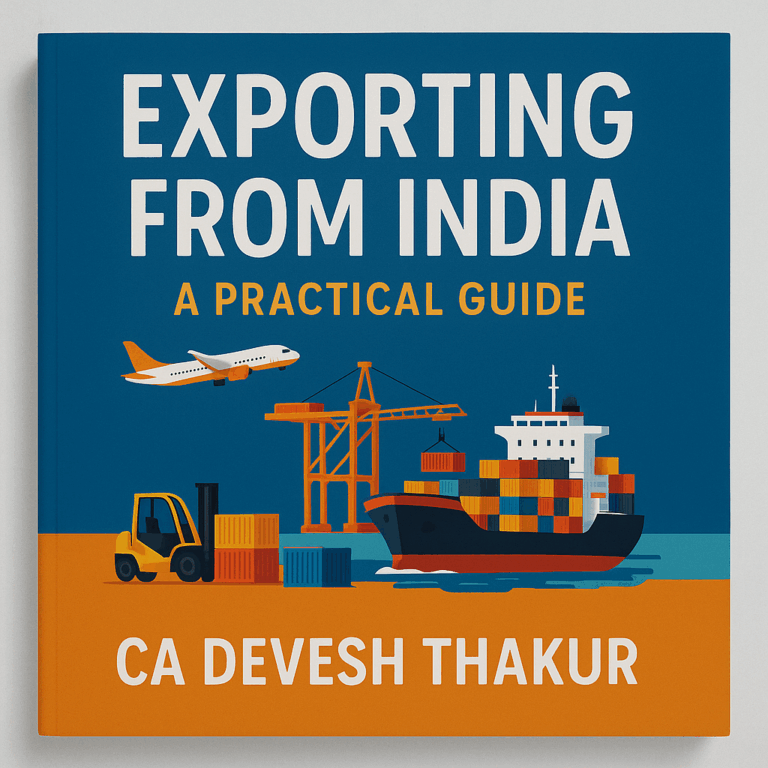
The Ultimate Guide to
Exporting from India
Regulations · Incentives · Logistics — A practical guide for entrepreneurs and businesses looking to engage in international trade from India
I. The Strategic Importance of Exporting
Exporting is a fundamental driver of growth for any economy, with profound impacts at both the national level and for individual businesses. India’s export ecosystem offers remarkable opportunities backed by government support and robust infrastructure.
Macroeconomic Benefits
Exports influence a country’s GDP, exchange rates, inflation, and interest rates. They boost foreign currency reserves, stimulate industrial production, and generate higher tax revenue for the government.
Business Benefits
Higher profit margins by leveraging cost differences, economies of scale from increased production, improved liquidity through advance payment terms, and enhanced competitiveness through global exposure.
Strategic Advantages
Access to less competitive international markets, diversification of revenue streams, reduced dependence on domestic demand cycles, and opportunities to benchmark quality globally.
II. Setting Up an Export Business
Establishing a legal entity is the first critical step. All businesses must register under the Companies Act of 2013. Choosing the right structure impacts liability, taxation, and operational flexibility.
| Entity Type | Key Features | Best For |
|---|---|---|
| Private Limited Company | 2–15 directors, 2–200 shareholders, ₹1,00,000 min capital | SMEs & Startups |
| Public Limited Company | Shares publicly tradable on stock exchange | Large Businesses |
| LLP | Limited liability, business assets distinct from personal assets | Professionals |
| One Person Company (OPC) | Single owner with full liability protection | Solo Entrepreneurs |
| Sole Proprietorship | Easiest to set up, owner liable for all obligations | Very Small Business |
| Partnership Firm | Governed by Indian Partnership Act 1932, shared P&L | Family Business |
📋 Key Company Formation Documents
- DIN — Director Identification Number: Mandatory for all directors
- MOA — Memorandum of Association: The “charter of a company” — defines its constitution, scope, and objectives
- AOA — Articles of Association: Internal rules governing conduct of business; subordinate to the MOA
- RoC — Registrar of Companies: Registers all companies and LLPs in India
III. IEC Code & Essential Registrations
Bank Account
A Current Account with a Bank authorized to deal in Foreign Exchange is essential for all international transactions and receiving export proceeds.
PAN Card
Permanent Account Number is mandatory for every exporter and importer. Obtained from the Income Tax Department.
IEC Code
The Importer-Exporter Code — a key business identification number mandatory for all imports and exports. Post-GST, IEC = PAN of the firm.
🔑 IEC — Everything You Need to Know
- Issued by: DGFT (Directorate General of Foreign Trade)
- Application: Online via DGFT website with PAN, mobile/email verification, entity details & documents. Fee: ₹500
- Validity: Lifetime — no renewal required
- Required for: Customs clearance, international fund transfers, Food Licensing, APEDA Licensing
- Post-GST: IEC number is now the same as the PAN of the firm, though separately issued by DGFT
📜 RCMC — Registration-Cum-Membership Certificate
Validates an exporter’s registration with an authorized Indian Government agency. Necessary to avail government benefits and export incentives.
- Issued by 27 Export Promotion Councils and 9 Commodities Boards in India
- Multi-product exporters or those not covered: FIEO (Federation of Indian Exporters Organisation) issues RCMC
IV. ITC-HS Codes & Trade Policy
India uses the ITC-HS (Indian Trade Classification based on Harmonized System) to classify goods and define import/export policies. Managed by DGFT, it’s an 8-digit code system.
| Code Digits | What It Represents | Example |
|---|---|---|
| First 2 digits | Chapter (broad category) | 09 = Coffee, Tea, Spices |
| First 4 digits | Heading (product group) | 0902 = Tea |
| First 6 digits | Sub-Heading (international standard) | 090210 = Green Tea |
| All 8 digits | Regional Tariff (India-specific) | 09021010 = Green Tea, in packages ≤3 kg |
Import Categories
Restricted (need license) · Canalized (via specific agencies) · Prohibited (banned entirely) · Freely Imported (no restriction with valid IEC)
Export Categories
Restricted (need explicit license) · Prohibited (cannot be exported at all) · STE (via designated State Trading Enterprises) · Freely Exportable (most items)
V. The Export Process — Step by Step
-
1
Market Selection
Research market size, competition, quality requirements, and payment terms. Consider Demand, Distance, Freight costs, Free Trade Agreements, and Accessibility.
-
2
Finding Buyers
Participate in trade fairs, buyer-seller meets, exhibitions, B2B portals, web browsing. Maintain multilingual websites for broader reach.
-
3
Sampling & Pricing
Provide customised samples per buyer demands. Price based on all expenses from sampling to realisation of export proceeds using Incoterms and FTAs/PTAs.
-
4
Risk Coverage via ECGC
The Export Credit Guarantee Corporation (ECGC) provides policies to cover payment risks due to buyer/country insolvency. Essential for new markets.
-
5
Order Processing
Confirm order → Procure/manufacture goods to buyer spec → Quality control → Labelling, packaging & marking → Marine insurance → Customs & shipping bill filing.
-
6
Customs & Shipping Bill
File a Shipping Bill/Bill of Export — mandatory customs document. Exporters need a PAN-based BIN from Customs prior to filing. Most declarations submitted via EDI System.
📄 Essential Export Documents
VI. INCOTERMS 2020
INCOTERMS (International Commercial Terms) are universally accepted selling terms published by the ICC. They clearly define which tasks, costs and risks are associated with the buyer vs. the seller — critical for pricing and delivery negotiations.
Any Mode of Transport (7 Terms)
Sea & Inland Waterway Transport (4 Terms)
VII. Freight Forwarding & Cargo Logistics
Freight forwarders are crucial intermediaries managing the complexities of international shipping — from documentation to physical delivery.
6 Stages of Freight Forwarding
- 1
Export Haulage
Transport of goods from exporter’s premises to the freight forwarder’s warehouse at origin.
- 2
Export Customs Clearance
Approval for departure from origin country — filing of shipping bill, payment of duties if any.
- 3
Origin Handling & Checkpoint
Inspection, verification and checks for restricted items — flammable liquids, drugs, perishables etc.
- 4
Import Customs Clearance
Checking paperwork and legality at destination country — potential import duties and fees apply.
- 5
Destination Handling
Preparing goods for final delivery — handling invoices, Bill of Lading, packing lists and other documents.
- 6
Import Haulage
Final transport from import warehouse to the buyer’s destination address.
Containerised Cargo
Goods shipped in reusable standardised containers — significantly reduces costs and has driven globalisation. Types: Dry Cargo, Open Top, High Cube, Reefer (refrigerated), GOH, Tanker, Flat Track, and more.
Break Bulk (Non-Containerised)
Goods shipped in pieces without a container — typically extremely large or oddly shaped cargo. Transported in crates, bags, boxes, drums, or barrels. Higher handling cost.
Cold Chain Logistics
Ensures integrity of temperature-sensitive products — reduces spoilage, retains quality. Components: cold storages, refrigerated carriers, specialised packaging, MIS-based monitoring.
VIII. Government Schemes & Export Incentives
🌐 Key Regulatory Agreements
- SPS Agreement (WTO) — Sanitary & Phytosanitary standards: food safety and animal/plant health regulations. Standards must be science-based and non-discriminatory.
- TBT Agreement (WTO) — Technical Barriers to Trade: ensures technical regulations are non-discriminatory and don’t create unnecessary trade obstacles.
Export Promotion Schemes (Financial Incentives)
RoDTEP
Remission of Duties or Taxes on Export Products. Covers all hidden Central, State & Local duties/taxes. WTO compliant.
Advance Authorisation (AA)
Allows duty-free import of inputs used for export production.
DFIA Scheme
Duty Free Import Authorisation — duty-free import of inputs with minimum 20% value addition.
Duty Drawback
Refunds customs duties paid on inputs that were subsequently used in exported products.
EPCG Scheme
Import capital goods at zero customs duty for producing export quality goods — subject to export obligation.
Interest Equalisation (IES)
Interest equalization (subsidy) on Pre & Post Shipment Rupee Export Credit from banks.
EOU / EHTP / STP
Export Oriented Units: import/domestic procurement without duties, commit to 100% export production.
MAI Scheme
Market Access Initiative — financial assistance for export promotion activities and market development.
Status Holder Scheme
Recognises top exporters as “Star Export Houses” — grants non-fiscal privileges and fast-track benefits.
🏗️ Major Policy Initiatives
- Make in India — Facilitate investment, foster innovation, build infrastructure, make India a manufacturing hub
- PLI Scheme — Production-linked Incentive for 14 key sectors, outlay of ₹1.97 lakh crore
- PM Gati Shakti NMP — GIS-based platform for integrated multimodal infrastructure planning, reducing logistics cost
- National Logistics Policy (NLP) — Reduce logistics cost to match developed-country benchmarks
- SEZs & EOUs — Special Economic Zones designed for export promotion, investment, employment & infrastructure
- NSWS — National Single Window System for end-to-end investor facilitation
IX. Trade Statistics & Outlook
| Category | Major Exports | Major Imports |
|---|---|---|
| Key Commodities | Petroleum Products, Iron & Steel, Pharmaceutical Products | Vegetable Oils, Coal, Organic Chemicals, Computer Hardware |
| E-Commerce | Current: $5–10B annually | Projected: $200–300B by 2030 |
💱 Foreign Exchange Risk
Exchange rate fluctuation is a natural outcome of floating rates, influenced by economic performance, inflation outlook, interest rate differentials, and capital flows. Exporters must hedge their foreign currency risk via instruments such as futures, forwards, and options.
X. Customs Declaration Forms — CN22 & CN23
These forms accelerate customs clearance by detailing contents, value, and origin of postal shipments. The sender bears full liability for accuracy — a false declaration may lead to a fine or seizure.
CN22
Smaller form (74 × 105 mm). Used for items with declared value up to 300 SDR. Simpler fields covering contents, value, and country of origin.
CN23
Larger form (210 × 148 mm). Required when value is more than 300 SDR. Includes detailed sender/importer information, HS tariff numbers, licence numbers, and a comments section for quarantine/restrictions.
⚠️ Common CN22/CN23 Requirements
- Description: Generic terms like “clothes” or “food products” are NOT acceptable — must be specific
- HS Tariff Number: 6-digit code, recommended for all commercial items
- Country of Origin must be clearly stated
- Reason for Export: “Gift” is not acceptable for commercial items — use “Sale of Goods” or “Commercial Sample”
- Total weight, total value, and quantity per article must be accurate
XI. ICEGATE — Indian Customs EDI Gateway
ICEGATE and the DGFT portal are critical digital platforms for trade facilitation in India, enabling end-to-end customs and export management online.
IEC Management
View, manage and update IEC details, verify UDIN, profile management on DGFT portal.
Authorizations
Advance Authorisation/DFIA applications, EPCG licensing, Export obligation tracking.
Export Incentives
SEIS, RoSCTL, Transport & Marketing Assistance, Interest Equalisation applications.
Import/Export Systems
Import/Export Management Systems, Online e-COM Applications, EDI gateway for shipping bills.
Certificates
Certificate of Origin, Certificate Management, Deemed Export Benefits, Pre-Shipment Inspection.
Payments & Refunds
e-Miscellaneous Payments, e-Refunds, E-RCMC registrations, Gems & Jewellery Schemes.
XII. Key Trade Terms — Quick Glossary
📥 Download the Complete Export Guide E-Book
Get the full practical guide by CA Devesh Thakur as a PDF — free to download, packed with checklists, forms, and step-by-step processes.
📄 Download Free E-Book — Exporting from India