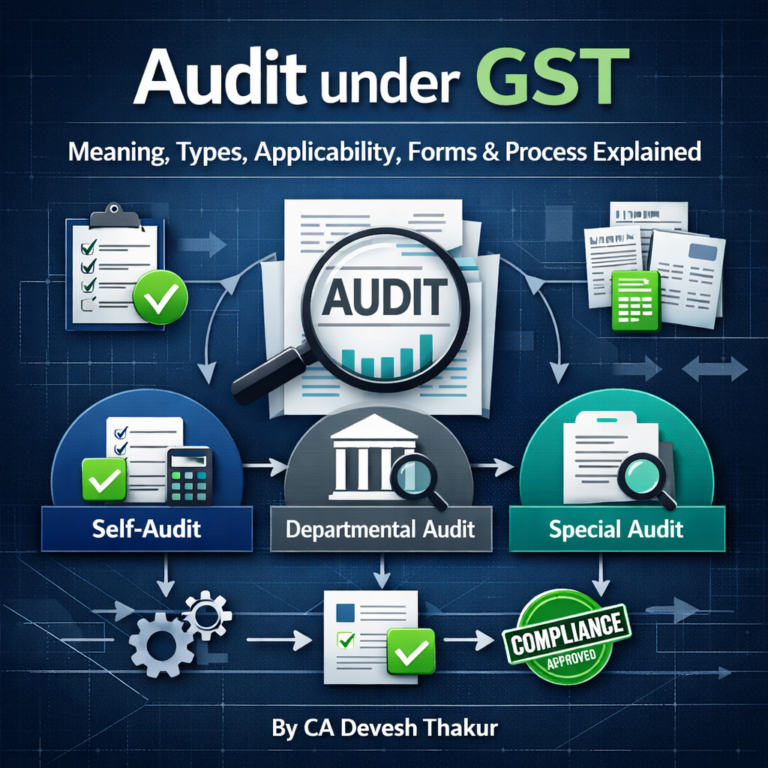
Audit under GST Law – Section 65 & Section 66 Explained with Examples
The Goods and Services Tax (GST) in India is based on self-assessment – taxpayers calculate their liability and pay tax themselves. But how do authorities ensure that taxpayers are doing this honestly and correctly?
This is where audits come into play. Audits are tools available to the tax department to check compliance, prevent tax evasion, and plug revenue leakage. Let’s break down the concept of GST audits under Section 65 and Section 66 of the CGST Act, 2017 in simple language, with practical illustrations.
1. What is an Audit under GST?
As per Section 2(13) of the CGST Act, an audit means:
Examining records, returns, and other documents maintained by a registered person to verify correctness of turnover, taxes paid, refunds claimed, and input tax credit (ITC) availed, and to assess compliance with GST law.
So, the main objectives of audit are:
- Check if turnover declared is correct,
- Ensure taxes are paid properly,
- Verify refunds claimed,
- Confirm ITC has been availed/used correctly,
- Ensure compliance with GST provisions.
2. Types of Audit under GST
There are two main types:
- Audit by Tax Authorities (Section 65) – conducted by GST officers.
- Special Audit (Section 66) – conducted by a Chartered Accountant or Cost Accountant nominated by the Commissioner.
3. Audit by Tax Authorities (Section 65, Rule 101)
This is the standard audit undertaken by GST officers.
(A) Who can conduct?
- The Commissioner or any officer authorized by him.
- Only registered persons can be audited.
(B) Example
Mr. X runs a trading business and files GST returns showing turnover of ₹2 crore. During routine scrutiny, the GST department notices a mismatch between GSTR-3B (monthly return) and GSTR-2A (purchase records). The Commissioner orders an audit under Section 65 to verify ITC claims.
(C) Where is audit done?
- At the taxpayer’s place of business, or
- At the tax office.
(D) Notice Requirement
- A notice in FORM GST ADT-01 must be given at least 15 working days before audit begins.
(E) Timeline
- Audit must be completed within 3 months from commencement.
- Commissioner can extend by 6 more months (total 9 months).
(F) Taxpayer’s Duties During Audit
- Provide access to books of accounts, invoices, returns.
- Furnish information asked by the officer.
- Assist officers to complete audit.
(G) Conclusion of Audit
- Within 30 days of completion, findings are communicated in FORM GST ADT-02.
- If discrepancies are found (say ITC wrongly claimed of ₹5 lakh), the officer cannot directly demand tax.
- He must issue a Show Cause Notice (SCN) under Section 73 (non-fraud) or Section 74 (fraud).
4. Special Audit (Section 66, Rule 102)
Sometimes, issues are too complex for departmental officers to verify. In such cases, a special audit is ordered.
(A) Who can order?
- An officer not below Assistant Commissioner, but only after approval of Commissioner.
(B) When is it ordered?
If the officer feels:
- Value is not correctly declared, OR
- ITC claimed is abnormally high,
considering complexity of case and interest of revenue.
(C) Example
Company Y is engaged in exports and claims huge refunds of ITC every quarter. During scrutiny, officers doubt that the company is inflating purchase invoices to claim higher ITC. Since the case is complex and involves large amounts, the Assistant Commissioner orders a Special Audit under Section 66 with approval of the Commissioner.
(D) Who conducts?
- A Chartered Accountant or Cost Accountant, nominated by the Commissioner.
- The taxpayer cannot choose the auditor.
(E) Timeline
- Auditor submits report in FORM GST ADT-04 within 90 days.
- Extension of another 90 days may be granted if necessary.
(F) Cost of Special Audit
- Entire expense, including auditor’s remuneration, is paid by the Commissioner.
(G) Rights of Taxpayer
- Taxpayer must be given an opportunity of being heard before any findings are used against him.
(H) If Discrepancies Found
- Suppose the Special Audit shows Company Y wrongly availed ITC of ₹50 lakh.
- Officer cannot straightaway raise demand. He must issue a Show Cause Notice under Section 73/74 and then pass an order after considering the reply.
5. Key Differences Between Section 65 & Section 66
| Particulars | Audit by Tax Authorities (Sec 65) | Special Audit (Sec 66) |
| Conducted by | GST Officers | CA/Cost Accountant nominated by Commissioner |
| Ordered by | Commissioner/authorized officer | Assistant Commissioner (with Commissioner’s approval) |
| When applied | Routine/periodic audit | Complex cases, abnormal ITC, incorrect value |
| Notice issued | FORM GST ADT-01 | FORM GST ADT-03 |
| Report form | Findings in FORM GST ADT-02 | Audit report in FORM GST ADT-04 |
| Time limit | 3 months (extendable up to 9 months) | 90 days (extendable by 90 days) |
| Expenses | Not specified (department bears) | Borne by Commissioner |
6. Why are Audits Necessary in GST?
- Ensures correctness of self-declared turnover, tax, refunds, and ITC.
- Detects tax evasion and revenue leakage.
- Promotes fairness among businesses.
- Builds confidence in the GST system.
7. Conclusion
Audits under GST act as checks and balances in a self-assessment system.
- Section 65 audits are routine checks conducted by tax officers.
- Section 66 audits are special audits in complex cases requiring professional expertise.
In both situations, taxpayer rights are protected. No demand can be raised without issuing a Show Cause Notice and giving the taxpayer a chance to respond.
Audits strengthen compliance, reduce fraud, and improve trust in the GST system.
Connect with CA Devesh Thakur
Stay updated with structured Income Tax learning, section-wise breakdowns, practical insights, and regular tax updates across platforms: