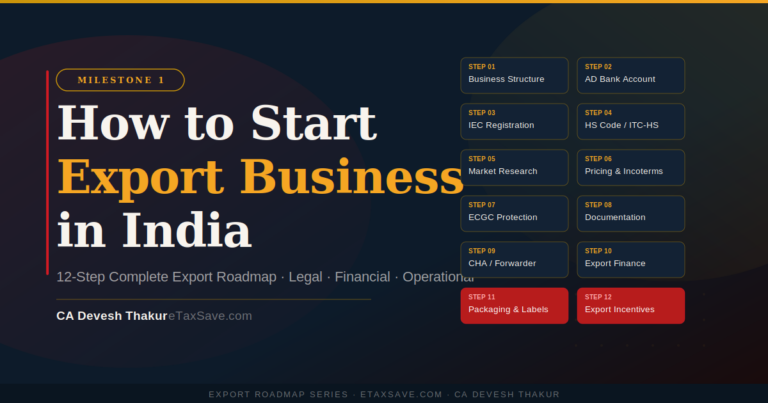
How to Start Export Business
in India
A Complete 12-Step Export Roadmap — legal structure, IEC, market research, ECGC, finance, packaging & incentives.
12 Steps to Start Exporting from India
Your business structure affects taxation, liability, compliance burden, banking facilities, and buyer credibility.
Best for beginners. Easy to start, unlimited liability.
Suitable for family businesses. Requires partnership deed.
Limited liability, fewer compliance obligations.
Most preferred for serious exporters & corporate clients.
Only Authorised Dealer (AD) Banks can handle forex transactions. Mandatory for receiving export proceeds, BRC, and FEMA compliance.
- PAN of business
- Business registration proof
- Address proof
- GST registration (if applicable)
- KYC documents of directors/partners
IEC is your primary export authorization issued by DGFT. Without IEC, you cannot file shipping bills, clear customs, or claim export incentives.
- Generated online via DGFT portal
- PAN-based with lifetime validity
- Aadhaar-based OTP verification
- IEC = your identity in international trade
Every export product must be classified under ITC-HS. The HS Code determines export policy, tariff structure, and documentation requirements.
- Export policy (free / restricted / prohibited)
- Tariff structure & documentation
- Buyer country import duty
Research where your product can actually sell. Analyze country demand, price benchmarking, import regulations, and competitor pricing.
- Export Promotion Councils (EPCs)
- Trade fairs and exhibitions
- B2B Portals (Alibaba, IndiaMART, TradeIndia)
- LinkedIn Export Networking
- Indian Embassies Trade Cells
Export pricing includes manufacturing cost, packaging, inland transport, customs, freight, insurance, and banking charges. Incoterms define cost-sharing and risk transfer.
ECGC protects exporters from buyer default, political risk, payment delays, and insolvency risk. Every new exporter must take ECGC coverage.
- Protects working capital
- Improves bank financing eligibility
- Covers buyer default & political risk
- Covers payment delays & insolvency
Documentation is the most sensitive part of international trade. Even a small mismatch can result in payment delay or customs objections.
- Commercial Invoice
- Packing List
- Shipping Bill
- Bill of Lading / Airway Bill
- Certificate of Origin
- Insurance Certificate
- Inspection Certificate
- Letter of Credit (if applicable)
Choose the right logistics partners for a smooth export flow. A Freight Forwarder manages cargo; a CHA handles customs clearance.
- FF: Cargo booking, freight negotiation, warehouse, tracking
- CHA: Customs clearance, HS code validation, duty access, paperwork filing
Export finance improves liquidity and reduces business stress across two key stages of the export lifecycle.
- Packing Credit (Pre-Shipment): Raw materials, labour, packaging
- Post-Shipment Finance: Bill discounting, LC negotiation, invoice funding
International packaging must meet moisture resistance, load-bearing capacity, and country-specific import regulations. Labels must comply with destination country norms.
- Exporter name & consignee name
- Country of origin
- HS Code
- Weight & handling symbols
The Indian government supports exporters through multiple schemes to improve international price competitiveness.
- 27 Export Promotion Councils (EPCs)
- RCMC Registration
- MAI – Market Access Initiative
- Transport & Marketing Assistance
- E-commerce export benefits up to ₹10 lakh
Key Terms Glossary
| Short Form | Full Form |
|---|---|
| IEC | Importer Exporter Code |
| DGFT | Directorate General of Foreign Trade |
| ITC-HS | Indian Trade Classification – Harmonised System |
| CHA | Customs House Agent |
| ECGC | Export Credit Guarantee Corporation |
| FOB | Free On Board |
| CIF | Cost Insurance Freight |
| BL | Bill of Lading |
| AWB | Airway Bill |
| EPC | Export Promotion Council |
| RCMC | Registration Cum Membership Certificate |
Export is not a shortcut business — it is a system-driven process that requires legal compliance, financial discipline, documentation accuracy, and risk management.
This 12-step Export Roadmap gives you a solid legal and practical foundation to confidently start exporting from India.