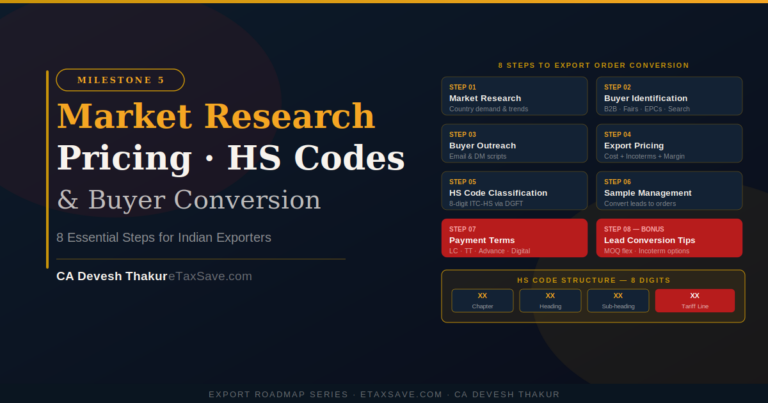
Market Research, Pricing,
HS Codes & Buyer Conversion
8 essential steps — from market analysis to pricing strategy, HS code understanding, communication techniques, and professional negotiation.
Effective exports begin with informed decision-making. Research helps you understand where your product has actual demand and what quality standards buyers expect.
- Import volume trends of your product
- Target country demand and purchasing behaviour
- Competitor analysis (pricing, quality, market share)
- Regulatory requirements (certifications & labelling)
- Trade agreements offering duty benefits to Indian exporters
Tools: Trade statistics platforms, Export Promotion Councils, Indian embassies abroad, Online demand analysis using HS code data
- Global B2B Platforms: Alibaba, Global Sources, IndiaMART Global, TradeIndia, ExportersIndia — with complete profiles (images, MOQ, certifications, payment terms)
- International Trade Fairs: Canton Fair, Dubai fairs, Germany’s Heimtextil, IHGF Delhi Fair
- Buyer-Seller Meets via EPCs: Reduce risk, improve conversion, access verified buyers
- Direct Research-Based Outreach: “Importers of [your product] in USA” or “Wholesale distributors for [product] in Europe”
“Hello, we are an Indian exporter of [product] under HS Code [code]. We supply across multiple countries and follow global quality parameters. May I share our catalogue and pricing?”
Subject: Trusted Export Partner from India for [Product]
Dear [Buyer Name], we are an accredited exporter from India, offering [product] with complete compliance and quality assurance. We provide flexible shipment terms (FOB/CIF/DDP), customised packaging, and timely dispatch.
Accurate pricing is essential for sustainability. Export pricing must cover all direct and indirect costs involved until the goods reach the buyer.
- Manufacturing/Procurement Cost: Raw material, labour, packaging, utilities
- Export-Related Expenses: Inland transport, CHA, freight, marine insurance, banking, ECGC
- Incoterm-Based Additions: FOB, CIF, CFR, DDP — each shifts responsibility
- Profit Margin: Usually 10–30% depending on product segment
HS Codes are globally recognized product classification numbers that determine duties, restrictions, compliance norms, and trade policies.
| First 2 digits | Chapter |
| Next 2 digits | Heading |
| Next 2 digits | Subheading |
| Last 2 digits | Precise Tariff Line |
Use DGFT, customs portals, or search “HS Code for [product] India” for validated listings. Correct classification avoids delays and customs issues.
Samples are the first tangible experience buyers have with your product. High-quality samples significantly improve the chance of receiving a bulk order.
- Neatly packed samples
- Branding or label inclusion
- Quick dispatch
- Customisation when requested
- Clear communication on sample cost (if applicable)
Selecting secure payment terms is critical, especially for new exporters. Assess buyer credibility before finalizing terms.
- Advance Payment: Part advance + balance before shipment
- Letter of Credit (LC): Bank-backed assurance
- Documentary Collection: Payment through bank documents
- Digital Payments: Stripe, PayPal (mainly for small/e-commerce shipments)
Small gestures make your business appear buyer-friendly and professional, and significantly improve your conversion rate.
- MOQ Flexibility: Offer a lower starting MOQ for first-time buyers — reduces their risk and encourages trial orders
- Flexible Incoterms: Providing options like FOB, CIF, or DDP helps buyers choose based on convenience
Key Terms Glossary
| Short Form | Full Form |
|---|---|
| HS Code | Harmonized System Code |
| IEC | Importer Exporter Code |
| EPC | Export Promotion Council |
| RCMC | Registration-Cum-Membership Certificate |
| FTA | Free Trade Agreement |
| PTA | Preferential Trade Agreement |
| MOQ | Minimum Order Quantity |
| DGFT | Directorate General of Foreign Trade |
| CHA | Customs House Agent |
| FOB | Free On Board |
| CIF | Cost, Insurance & Freight |
| CFR | Cost and Freight |
| DDP | Delivered Duty Paid |
| LC | Letter of Credit |
| ECGC | Export Credit Guarantee Corporation |
| MSME | Micro, Small & Medium Enterprises |
Building a successful export business is not just about obtaining IEC or identifying products. The real turning point begins when you learn how to connect with genuine overseas buyers and convert opportunities into long-term export orders.