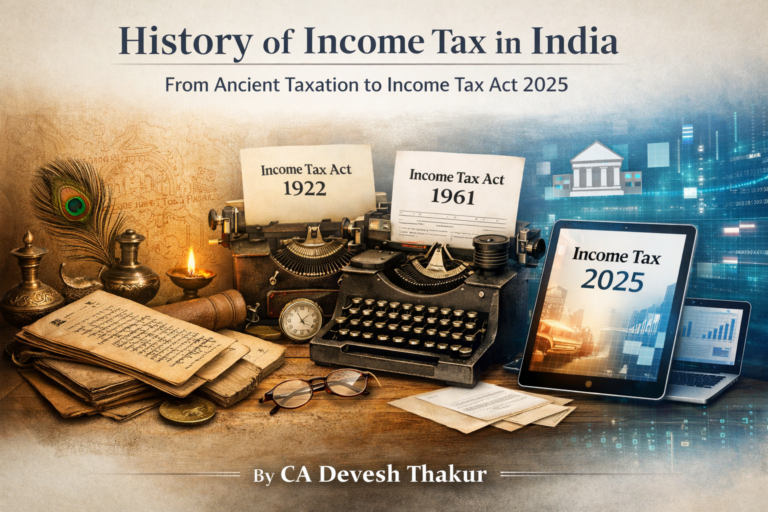
Income Tax in India Is 2500 Years Old: From Ancient Taxation to the New Income Tax Act 2025
Most people believe that income tax in India was introduced by the British.
That belief is completely wrong.
India’s system of direct taxation is more than 2500 years old, deeply rooted in ancient philosophy, governance, and public welfare. Long before modern governments, ancient Indian thinkers like Manu, Kautilya, and Kalidasa had already laid down clear principles on how taxes should be collected, how much should be charged, and—most importantly—why taxes exist.
From Manu Smriti and Arthashastra to the Income Tax Act, 1961, and now the upcoming Income Tax Act, 2025, India’s tax system has continuously evolved to reflect economic realities, social needs, and technological progress.
This article explores the complete history of income tax in India, from ancient times to the modern digital era.
Taxation Was Never Meant to Exploit: Kalidasa’s View
Kalidasa, one of India’s greatest poets, beautifully explained taxation in Raghuvansh while praising King Dilip:
“A king collects taxes just as the sun draws moisture from the earth—only to return it a thousandfold.”
This single line captures the core philosophy of Indian taxation:
- Taxes are collected for public welfare
- The ruler is a trustee, not an owner
- Taxation must benefit citizens, not burden them
This idea remains relevant even today.
Taxation in Ancient Civilizations Around the World
India was not alone in practicing taxation. Ancient civilizations across the world also imposed taxes, mainly to fund governance and defence.
| Civilization | Type of Tax | Purpose |
| Roman Empire | Property & trade taxes | Military & administration |
| Greece | Occupation-based taxes | Public expenditure |
| Germany | Turnover taxes | State functions |
| Medieval England | Land & customs duties | Wars & governance |
However, India stood apart because taxation here was closely tied to ethics and fairness, not just revenue collection.
Manu Smriti’s Tax Principles: Ability-Based Taxation
Manu Smriti provides one of the earliest structured approaches to taxation.
Who Paid How Much?
| Category | Tax Rate |
| Traders & artisans | 1/5th of profits |
| Agriculturists | 1/6th to 1/10th of produce |
| Performers (actors, dancers, musicians) | Income-based |
| Students & sick persons | Exemptions |
Key Principles from Manu Smriti
- Tax should be based on capacity to pay
- Excessive taxation must be avoided
- Collection should be smooth and non-harsh
- Taxes could be paid in gold, grains, cattle, or services
This clearly shows that progressive taxation existed in India thousands of years ago.
Kautilya’s Arthashastra: India’s First Complete Tax System
Written around 300 BC, Kautilya’s Arthashastra is arguably the world’s first detailed book on public finance and tax administration.
Types of Taxes in Arthashastra
| Tax Type | Description |
| Land revenue | 1/6th of agricultural produce |
| Income tax | On professionals & performers |
| Sales tax | On goods and property |
| Customs duty | ~20% on imports |
| Mining & forest tax | On natural resources |
| Salt tax | At point of production |
| Gambling tax | State-controlled |
Kautilya even introduced concepts similar to excess profit tax and presumptive taxation.
Tax Philosophy of Kautilya
- The king is only a trustee of land
- Taxes are payment for protection and services
- If the king fails, citizens have the right to resist taxation
- Poor, students, and the sick deserved relief or exemption
This philosophy closely resembles modern ideas of social contract and fiscal responsibility.
Medieval India to British Rule: The Shift Before 1922
During medieval times, taxation became more land-centric and was often collected by local rulers and zamindars.
With British rule:
- Taxation became centralized
- Revenue focus increased
- Administrative machinery expanded
However, there was still no single comprehensive income tax law—until 1922.
Birth of Modern Income Tax: The Income Tax Act, 1922
The Income Tax Act, 1922 marked the beginning of modern direct taxation in India.
Why It Was Important
- Defined income tax authorities
- Introduced structured assessments
- Created appellate mechanisms
- Established central tax administration
This Act laid the foundation for today’s tax system, but over time it became complex due to frequent amendments.
Post-Independence Evolution (1947–1961)
After Independence, India’s economy expanded rapidly. With growth came new challenges:
- Rising incomes
- Tax evasion
- Black money
To address this, several new laws were introduced:
- Wealth Tax Act
- Gift Tax Act
- Estate Duty
- Voluntary Disclosure Schemes
It became clear that India needed a modern, comprehensive income tax law.
Income Tax Act, 1961: The Backbone of Indian Taxation
The Income Tax Act, 1961, effective from 1 April 1962, replaced the 1922 Act.
Why It Succeeded
- Structured chapters and sections
- Clear computation mechanisms
- Defined powers and procedures
- Strong appellate framework
Even today, the 1961 Act remains the core law, though heavily amended over decades.
The Digital Revolution in Tax Administration
From the early 2000s, Indian taxation entered a digital era.
Major Milestones
- Introduction of PAN
- E-filing of returns
- Centralised Processing Centre (CPC), Bengaluru
- Faceless assessment and appeals
- AIS, TIS & 360° taxpayer profiling
This transformation reduced discretion, increased transparency, and improved compliance.
Why India Needed the Income Tax Act, 2025
Despite reforms, the Income Tax Act, 1961 had become:
- Lengthy
- Difficult to interpret
- Litigation-heavy
To address this, the government introduced the Income Tax Act, 2025, which will be applicable from 1 April 2026.
Core Objectives of the New Law
- Simplified language
- Logical structure
- Reduced sections
- Extensive use of tables
- Digital-first compliance
Income Tax Act 1961 vs Income Tax Act 2025 (At a Glance)
| Aspect | IT Act 1961 | IT Act 2025 |
| Language | Complex, legal | Simple, clear |
| Structure | Fragmented | Logical & consolidated |
| Compliance | Manual + digital | Fully digital |
| Interpretation | Litigation-heavy | Clarity-focused |
| User experience | Professional-dependent | Taxpayer-friendly |
What the Income Tax Act, 2025 Means for Taxpayers
- Easier understanding of law
- Lower compliance burden
- Reduced disputes
- Faster assessments
- Predictable outcomes
For professionals, it opens opportunities for advisory, transition support, and education rather than litigation.
What You Should Do Now
- Start understanding the structure of the new Act
- Compare provisions with the 1961 law
- Prepare for transition before 1 April 2026
To help with this, a 15-Day Income Tax Act 2025 Series will begin from 1 January 2026, covering:
- Major changes
- Section-wise comparison
- Practical impact on individuals and businesses
Conclusion: From Dharma to Digital Governance
India’s taxation journey is unique.
From ethical taxation based on dharma, to structured colonial laws, to digital, faceless governance, the evolution of income tax reflects India’s economic and social maturity.
The Income Tax Act, 2025 is not just a new law—it is the next chapter in a 2500-year-old story.
About the Author
Written by CA Devesh Thakur, Chartered Accountant and tax educator, actively engaged in explaining and simplifying Indian tax laws for students, professionals, and taxpayers.
Connect with CA Devesh Thakur
Stay updated with structured Income Tax learning, section-wise breakdowns, practical insights, and regular tax updates across platforms: