👉 Download the Ministry of Corporate Affairs Press Release on KYC Amendment
📌 Link: https://www.pib.gov.in/PressReleasePage.aspx?PRID=2210552&lang=1 (Press Information Bureau)
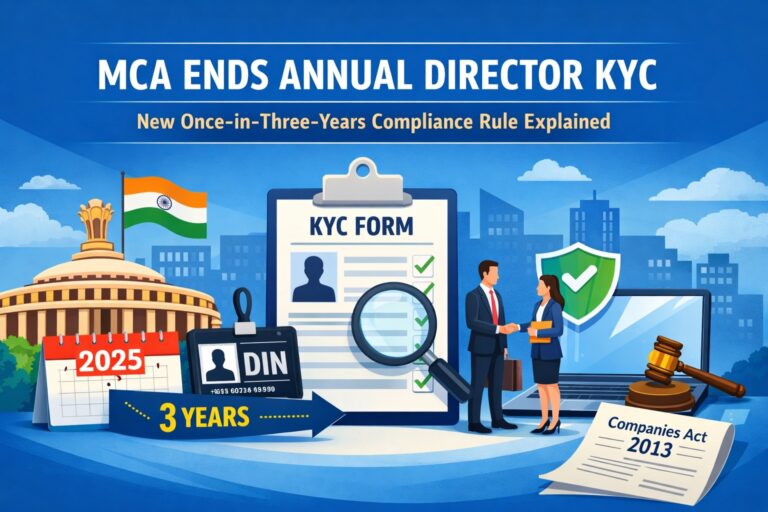
MCA Overhauls Director KYC: From Annual Burden to Once-in-Three-Years Simplicity
As part of the Azadi ka Amrit Mahotsav vision of simplifying compliance and improving ease of doing business in India, the Ministry of Corporate Affairs (MCA) has taken a significant regulatory step: phasing out annual KYC requirements for company directors under the Companies Act, 2013 and replacing them with a streamlined triennial model. (Press Information Bureau)
This change isn’t cosmetic — it’s a material reduction in repetitive compliance that hits a long-standing pain point for directors and professionals alike.
Why This Change Matters
For years, every individual holding a Director Identification Number (DIN) had to file a KYC return every single year just to keep their DIN active. Even when nothing changed — same phone number, same address, same email — directors still had to go through the procedural grind of annual filing. (Press Information Bureau)
That was compliance for the sake of compliance. It added recurring workloads to directors, company secretaries, chartered accountants, and compliance teams — with very little regulatory value in many cases.
The MCA’s new amendment finally acknowledges that frequent repetition without change does not add governance value.
What Exactly Changed?
✔️ Annual KYC → Triennial KYC (Once Every 3 Years)
Under the amended Rule 12A of the Companies (Appointment and Qualification of Directors) Rules, 2014:
- Directors now need to submit their KYC once every three years instead of every year.
- The amendment was notified on 31st December 2025 and takes effect from 31st March 2026. (Press Information Bureau)
This change applies to all directors who have already completed their KYC filings. Their next KYC due date will be 30th June, 2028. (Press Information Bureau)
If you haven’t submitted your KYC yet, you still can under existing rules until 31st March 2026 — but afterwards, the new three-year cycle applies. (Press Information Bureau)
Expanded Purpose of the New KYC Form
The revised simpler KYC form is designed to be multipurpose. You can use it for:
- Basic KYC compliance
- Updating mobile number
- Updating email address
- Updating residential address
- Re-activating DIN
✔️ These changes make it far more than just a periodic filing — it becomes a one-stop update mechanism. (Press Information Bureau)
Digital Signature Rules Tightened but Sensible
Here’s where you can breathe easy:
- Digital signature verification (by the director) and professional certification (by a CA / CS / CMA) will only be required when you are updating key details like mobile number, email, or residential address.
✔️ No more routine digital signatures on dry annual confirmations. (Press Information Bureau)
That’s a practical improvement — the verification now aligns with actual change events, which is what matters from a governance and data accuracy standpoint.
What This Means in Practice
📍 For Directors
- Less paperwork every year.
- A longer runway between mandatory filings.
- Greater focus on relevant updates rather than rote compliance.
📍 For Compliance Professionals
- Reduced annual churn of form filings.
- Better ability to track changes that actually matter.
- Less risk of unnecessary fines or DIN deactivations due to rushed annual filings as deadlines pile up.
📍 For the MCA System
- Reduced load on the MCA-21 portal.
- Better data quality (audited when changes happen).
- Fewer mechanical deactivations/activations due to portal congestion.
Is This Just Compliance Lite?
Yes — and no.
This change removes needless repetition, and that’s good. But it also raises the stakes for accuracy:
- Directors now must stay on top of changes to contact and address details because missing a 30-day update window can still have consequences. (Press Information Bureau)
The MCA is effectively saying: Don’t tell us the same thing over and over — only tell us when it matters.
🗓 Timeline at a Glance
| Event | Date |
| Amendment Notified | 31st Dec 2025 (Press Information Bureau) |
| Amendment Effective | 31st Mar 2026 (Press Information Bureau) |
| First Due Date under New Regime | 30th Jun 2028 (for directors with KYC already done) (Press Information Bureau) |
This change is good, but if you’re thinking it eliminates responsibility — think again.
The MCA has rebalanced compliance burdens, not abolished them. Directors and professionals now have:
- Less noise (no mindless annual filings),
- More focused compliance (updates only when needed),
- And greater accountability for changes that affect identity records.
If you’re still running KYC filings as if nothing has changed — stop. Update your compliance calendar. You will make mistakes if you assume “no news is good news”.
Connect with CA Devesh Thakur
Stay updated with structured Income Tax learning, section-wise breakdowns, practical insights, and regular tax updates across platforms: