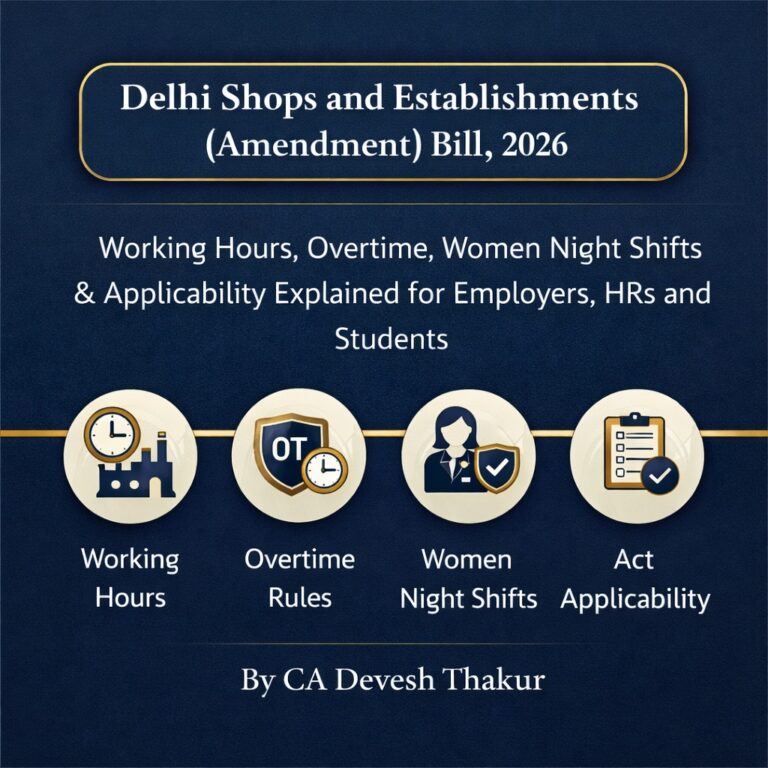
Delhi Shops and Establishments (Amendment) Bill, 2026 – Complete Analysis
By CA Devesh Thakur
Introduction
The Delhi Shops and Establishments (Amendment) Bill, 2026 marks a significant shift in labour law regulation within the National Capital Territory of Delhi. Introduced in the Delhi Legislative Assembly on 9 January 2026, the Bill seeks to amend the Delhi Shops and Establishments Act, 1954 to align it with modern business requirements, labour reforms suggested by the Government of India, and evolving workforce dynamics.
The amendments focus on working hours, overtime limits, applicability thresholds, and women’s employment during night hours, while attempting to maintain worker protection and promote economic activity.
Background of the Act
The Delhi Shops and Establishments Act, 1954 regulates working conditions in:
- Shops
- Commercial establishments
- Residential hotels
- Restaurants
- Theatres
- Other notified establishments
The Act governs hours of work, rest intervals, overtime, employment of young persons, and conditions of employment for women. Over time, the rigid structure of the Act was considered misaligned with current business realities, prompting the present amendment.
Key Amendments Introduced in 2026
1. Short Title and Commencement
The Act is officially titled the Delhi Shops and Establishments (Amendment) Bill, 2026 and shall come into force on a date notified by the Government of NCT of Delhi in the Official Gazette.
2. Applicability Threshold Increased (Section 1 Amendment)
New Provision:
The Act will now apply only to shops and establishments employing 20 or more employees.
Impact:
- Smaller establishments are excluded from the Act’s regulatory framework
- Compliance burden on small businesses is reduced
- Workers in small units lose statutory protections under this Act
This is a major structural change, clearly tilted towards improving ease of doing business.
3. Minimum Age for Employment (Section 2 Amendment)
- Minimum age increased from 12 years to 14 years
Impact:
- Aligns with child labour welfare principles
- Strengthens legal safeguards for minors
This amendment is socially progressive and legally consistent.
4. Working Hours Increased (Section 8 Amendment)
Daily Working Hours
- Increased from 9 hours to 10 hours
- Includes rest interval and lunch break
Weekly Working Limit
- Increased from 54 hours to 60 hours
Overtime Limits Revised
- Earlier: 150 hours per year
- Now: 144 hours per quarter
Impact:
- Employers gain flexibility in scheduling
- Employees face longer permissible working hours
- Quarterly overtime cap allows higher short-term workload concentration
This is one of the most debated amendments from a labour welfare perspective.
5. Rest Interval Relaxed (Section 10 Amendment)
- Mandatory rest interval required after 6 hours of continuous work
- Earlier requirement was 5 hours
Impact:
- Slight relaxation for employers
- Longer continuous working stretch for employees
6. Maximum Spread-Over Standardised (Section 11 Amendment)
- Maximum spread-over fixed at 12 hours
- Applicable uniformly to shops and commercial establishments
Impact:
- Simplifies compliance
- Standardises working limits across establishments
7. Employment of Women During Night Hours (Section 14 – Substituted)
This is the most significant and sensitive amendment.
Night Shift Timings Allowed (with consent):
- Summer: 9:00 PM to 7:00 AM
- Winter: 8:00 PM to 8:00 AM
Mandatory Conditions:
- Written consent of women employees
- CCTV surveillance, security arrangements, and transport facilities
- Minimum two women employees during night shift
- No employment for six weeks after childbirth or miscarriage
- Mandatory compliance with POSH Act, 2013
- Any additional conditions notified by Delhi Government
Impact:
- Encourages women’s workforce participation
- Shifts responsibility of safety heavily onto employers
- Effectiveness depends entirely on enforcement
This amendment is progressive in intent but execution-sensitive.
8. Prohibition on Night Work for Young Persons
- Absolute prohibition on employing young persons during night hours
This provision strengthens child and adolescent protection under labour laws.
Statement of Objects and Reasons
The Government aims to:
- Increase flexibility in working hours
- Revise overtime regulations
- Promote women’s employment with safeguards
- Raise applicability threshold
- Encourage employment generation and economic activity
- Maintain worker protection
These reforms were recommended by the Department for Promotion of Industry and Internal Trade (DPIIT).
Financial & Delegated Legislation Memorandum
- No financial burden on the Government
- Delhi Government empowered to notify conditions for women’s workplace safety
Overall Analysis
The Delhi Shops and Establishments (Amendment) Bill, 2026 is:
- Business-friendly in structure
- Flexible in working hour regulation
- Progressive in women’s employment
- Strict on paper, enforcement-dependent in reality
While it promotes economic activity and operational ease, it also normalises longer working hours, making enforcement and compliance monitoring crucial.
Conclusion
This amendment fundamentally changes labour compliance in Delhi. Employers, HR professionals, CA & law students, and advisors must update their understanding immediately, as reliance on the old Act can lead to incorrect compliance and advisory failures.
✍️ By CA Devesh Thakur
Connect with CA Devesh Thakur
Stay updated with structured Income Tax learning, section-wise breakdowns, practical insights, and regular tax updates across platforms: