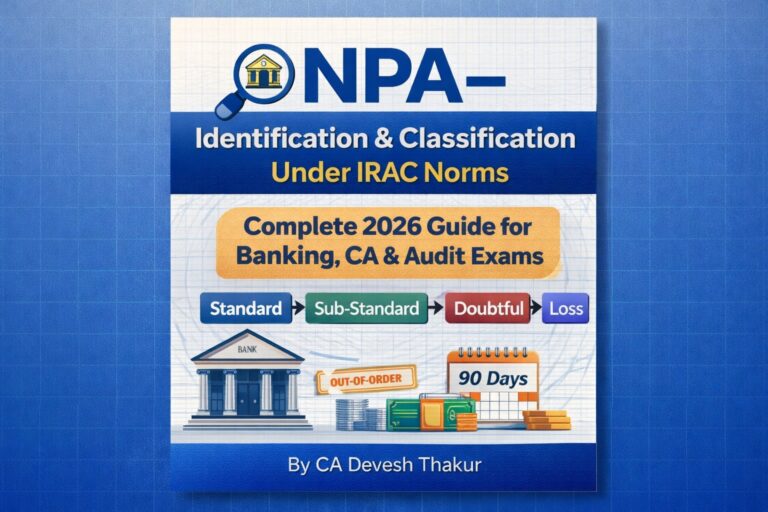
Non-Performing Assets (NPAs) are not just an exam topic. They are the backbone of banking risk assessment and financial reporting. If you misunderstand NPA classification, you misunderstand how the entire banking system measures stress.
Whether you are preparing for:
- CA Inter / CA Final (Audit & Financial Reporting)
- CMA / CS
- RBI Grade B
- IBPS PO / SBI PO
- Bank Branch Audit
- Credit Risk & Banking Interviews
This detailed guide will give you conceptual clarity — not just definitions.
Let’s break down NPA Identification and Asset Classification under RBI’s IRAC norms in a structured, practical manner.
What Is a Non-Performing Asset (NPA)?
A loan or advance becomes a Non-Performing Asset (NPA) when it stops generating income for the bank.
Under RBI’s Income Recognition and Asset Classification (IRAC) norms, asset classification is based purely on recovery performance, not on:
- Value of collateral
- Financial strength of borrower
- Personal guarantees
- Business reputation
This is where most students make a mistake. Banks do not wait for the borrower to “fail.” They look at overdue behavior.
The 90 Days Overdue Rule – The Core Trigger
The most fundamental rule in NPA classification is the 90-day overdue rule.
An asset becomes NPA when:
Interest and/or principal remains overdue for more than 90 days.
This applies across most credit facilities with certain variations.
NPA Identification Based on Type of Credit Facility
Let’s examine how NPA rules apply across different loan types.
1. Term Loans
For term loans:
- If interest or installment of principal remains overdue for more than 90 days → classified as NPA.
This includes home loans, vehicle loans, education loans, MSME loans, etc.
2. Cash Credit (CC) / Overdraft (OD)
Here the concept is slightly different. Instead of installment overdue, the test is whether the account is “Out of Order.”
An account is treated as out of order if:
- Outstanding balance remains continuously above sanctioned limit/drawing power for 90 days, OR
- No credits are received for 90 days, OR
- Credits are insufficient to cover interest debited during previous 90 days
If any of the above continues for 90 days → NPA.
This is commonly tested in bank audit and competitive exams.
3. Bills Purchased and Discounted
Bills that remain overdue and unpaid for more than 90 days are classified as NPA.
This is common in trade finance.
4. Agricultural Advances
Agricultural loans follow crop season logic instead of 90-day logic:
- Short duration crops → overdue for 2 crop seasons
- Long duration crops (longer than 1 year) → overdue for 1 crop season
This special treatment reflects agricultural income cycles.
5. Credit Card Accounts
If the minimum amount due remains unpaid for 90 days from payment due date → NPA.
6. Derivatives (Positive MTM Receivables)
Overdue receivables representing positive mark-to-market value unpaid for more than 90 days → treated as NPA.
Special Mention Accounts (SMA) – Early Warning Framework
Before an account becomes NPA, banks classify stressed accounts under SMA categories.
This is a preventive monitoring system.
| Category | Overdue Period |
| SMA-0 | 1–30 days |
| SMA-1 | 31–60 days |
| SMA-2 | 61–90 days |
Once it crosses 90 days → NPA.
Understanding SMA is critical for credit monitoring, restructuring decisions, and risk management.
System-Based Asset Classification (No Manual Manipulation)
RBI mandates:
- Automated IT-based classification
- Day-end system identification
- No manual override without approval
This reduces evergreening and window dressing.
For auditors, this means:
- Verify system-based IRAC tagging
- Check exception reports
- Test borrower-wise classification
Borrower-Wise Classification (Not Facility-Wise)
One of the most important IRAC principles:
Asset classification is borrower-wise.
If one loan account of a borrower becomes NPA, generally all other facilities granted to that borrower are also classified as NPA.
Example:
If borrower has:
- Term Loan (becomes NPA)
- Cash Credit
- Bank Guarantee
All facilities may be treated as NPA.
This prevents partial masking of stress.
Categories of Asset Classification After NPA Identification
Once identified as NPA, assets are further classified into four categories:
1. Standard Assets
- Performing assets
- No default
- Normal risk
These are not NPAs.
2. Sub-Standard Assets
- Remain NPA for ≤ 12 months
- Credit weaknesses exist
- Potential loss if deficiencies not corrected
This is the first stage of NPA.
3. Doubtful Assets
- Remain in sub-standard category for more than 12 months
- Full recovery highly improbable
- Security value uncertain
Risk increases significantly at this stage.
4. Loss Assets
- Identified as irrecoverable
- Either by bank, auditor, or RBI inspector
- Not yet fully written off
These are considered uncollectible.
Asset Classification Flow
Standard → Sub-Standard → Doubtful → Loss
This is a time-based progression combined with recoverability assessment.
Erosion of Security – Direct Classification Rules
Sometimes assets bypass normal ageing rules.
If realizable value of security falls drastically:
- Less than 50% of assessed value → Directly classified as Doubtful
- Less than 10% of outstanding exposure → Classified as Loss Asset
This is known as erosion of security.
Important for audit and inspection.
Special Circumstances in NPA Classification
Let’s address complex areas frequently asked in exams and audits.
1. Government Guarantee Cases
Central Government Guarantee
Loan becomes NPA only when the guarantee is repudiated after invocation.
However, income recognition is still based on realization.
State Government Guarantee
No special exemption. Normal NPA norms apply.
2. Projects Under Implementation (DCCO Concept)
Projects have a Date of Commencement of Commercial Operations (DCCO).
If delay exceeds permitted timelines:
- Account may be classified as NPA
- Even before operations begin
This is common in infrastructure financing.
3. Regularization Near Balance Sheet Date
Sometimes borrowers deposit small amounts before 31st March to avoid NPA classification.
Auditors must examine:
- Whether regularization is genuine
- Whether credits are sustainable
- Whether overdue persists
If not genuine → classify as NPA.
Window dressing must be prevented.
Why Correct NPA Classification Matters
Improper NPA classification affects:
- Provisioning requirements
- Profit & Loss Account
- Capital Adequacy Ratio (CAR)
- RBI supervisory actions
- Bank valuation
- Audit qualifications
Incorrect classification can lead to:
- Regulatory penalties
- Qualification in audit report
- Management accountability issues
Impact on Provisioning
Though not covered in detail here, remember:
Higher NPA category → Higher provisioning requirement.
Loss Assets → 100% provisioning.
Provisioning directly impacts bank profitability.
Role of Auditor in NPA Verification
If you are auditing a bank branch, your responsibilities include:
- Verifying overdue statements
- Checking system-based IRAC classification
- Testing borrower-wise tagging
- Reviewing security valuation
- Checking SMA monitoring
- Verifying provisioning calculations
- Identifying evergreening
Auditors must ensure compliance with RBI IRAC norms strictly.
Common Mistakes Students Make
Let’s be blunt.
Most students:
- Memorize 90-day rule only
- Ignore borrower-wise classification
- Forget agricultural exceptions
- Confuse Sub-Standard vs Doubtful
- Don’t understand erosion of security
Conceptual clarity matters more than rote memory.
Quick Concept Recap
- 90 days overdue → NPA
- Classification based on recovery, not security
- Borrower-wise tagging
- SMA is early warning system
- Sub-Standard ≤ 12 months
- Doubtful > 12 months
- Loss Asset = irrecoverable
- Security erosion can directly downgrade asset
Final Thoughts
NPA classification under IRAC norms is the foundation of:
- Banking risk management
- Credit monitoring
- Financial reporting
- Regulatory compliance
- Bank audits
If you truly understand NPA identification and asset classification, you understand how banks measure stress and protect capital.
This topic is not just theoretical. It defines the health of the banking system.
Download Advanced RBI-Grade Bank Audit Excel (Big 4–Style Working Paper)
If you want a structured, inspection-ready working paper instead of a basic checklist, you can download the Advanced RBI-Grade Branch Audit Excel Workbook. This upgraded version includes a weighted risk scoring model, automated High/Medium/Low risk calculation, conditional formatting to instantly flag high-risk areas, a branch risk heat map, and a dynamic dashboard with risk distribution charts. It is designed in a Big 4–style audit format with risk rating, materiality impact, sample size, CBS report references, and working paper tracking — making it ideal for statutory branch audits, RBI inspections, NPA review assignments, and CA Final Audit preparation.
👉 Download the Advanced Audit Excel Workbook here and start auditing like a professional.
Connect with CA Devesh Thakur
Stay updated with structured Income Tax learning, section-wise breakdowns, practical insights, and regular tax updates across platforms: