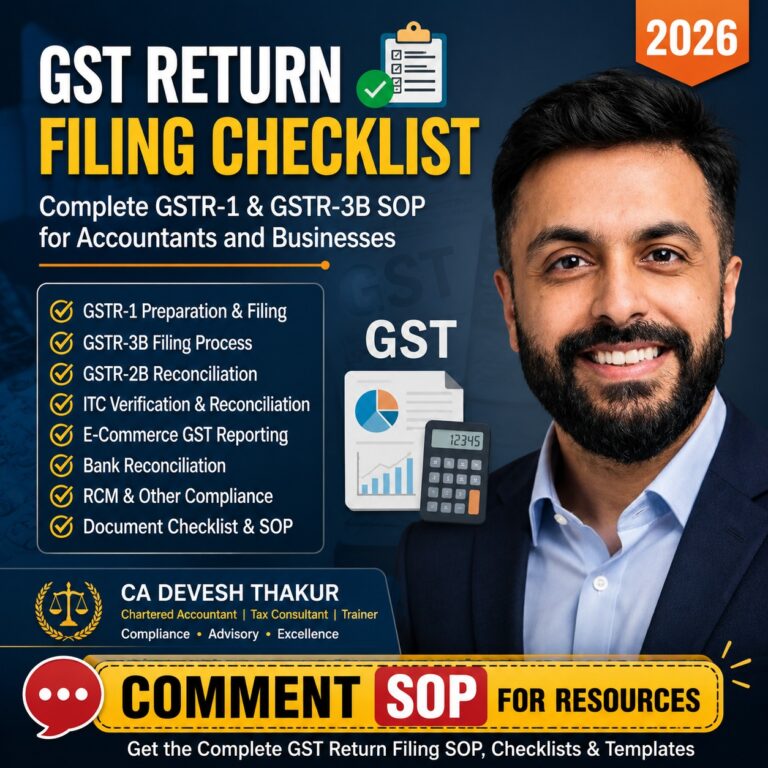
GST Return Filing
Document Checklist
The complete accountant’s SOP for monthly GSTR-1 + GSTR-3B compliance — from data collection to final filing.
Download the GST Filing Checklist PDF
All 17 sections · Printable checkboxes · A4 format · 100% Free
Follow first to unlock the download button
Basic Client Information
Foundational data required for return filing, notices, amendments, refunds, and export reporting.
- GST Registration Certificate
- PAN Card
- Aadhaar of Proprietor / Directors / Partners
- Trade Name & Legal Name
- Authorized Signatory Details
- GST Portal Login Access (optional but preferred)
- LUT Copy (if exports applicable)
- IEC Code (if imports / exports)
- Bank Details
Sales Data — GSTR-1 Core
GSTR-1 tables are entirely built from invoice classification. Ask for a proper Sales Invoice Register in Excel.
Required Fields in Register
- Invoice Number & Date
- Customer Name
- Customer GSTIN (if B2B)
- State / Place of Supply
- Taxable Value
- GST Rate (IGST / CGST / SGST)
- HSN / SAC Code
- B2B or B2C Flag
- Interstate or Intrastate
- E-commerce Platform (if any)
B2C Sales Details
- State-wise Sales Summary
- Tax-rate-wise Breakup
- Interstate vs Intrastate Segregation
- Daily Sales Report (if retail)
- POS-wise Summary
B2B Sales Documents
- All GST invoices issued to registered persons
- Customer GSTIN confirmation
- Invoice PDF copies (if possible)
- Debit Notes / Credit Notes issued
- Revised invoices (if amended)
- GSTIN validity of all customers
- Tax rate correctness
- Place of Supply (POS) accuracy
- Invoice sequence continuity
E-Commerce Reports
Clients routinely confuse settlement amount with taxable turnover — this creates wrong GST liability.
Monthly Reports to Collect
- Settlement Reports
- Transaction Reports
- TCS Reports
- GST Tax Reports
- Returns / Refunds Reports
- Commission Invoices
- Advertising Invoices
- Wallet Adjustments
Specifically Verify
- Gross Sales Amount
- Net Sales (after returns)
- Returned Orders
- Cancelled Orders
- TCS Deducted by platform
- Platform Fees charged
Credit Notes & Debit Notes
- Credit Note Register
- Debit Note Register
- Reason for issue of each note
- Linked original invoice reference
- GST impact calculation
- Whether GST reversal is required
- Whether already adjusted in books
Purchase Documents — ITC for GSTR-3B
Your GSTR-3B ITC claims must be backed by a proper purchase register. Incomplete data leads to incorrect claims.
Purchase Register Must Contain
- Supplier GSTIN
- Invoice Number & Date
- Taxable Value
- IGST / CGST / SGST split
- Expense Type / Nature
- RCM Applicability flag
Supporting Documents
- Purchase Invoices
- Expense Bills
- Freight Bills
- Office Expense Bills
- Rent Invoices
- Professional Fee Invoices
GSTR-2B Reconciliation
- Downloaded GSTR-2B from portal
- Purchase Register
- Vendor Ledger
- Missing Invoices in 2B
- Wrong GSTIN entries
- Duplicate ITC claims
- Blocked Credits (Section 17(5))
- Ineligible ITC items
Bank Statement
Bank reconciliation exposes unrecorded receipts, hidden turnover, cash settlements, and platform settlements that clients often miss unintentionally.
- Full bank statement for the filing month
- Reconcile all credits against recorded sales
- Identify platform settlement credits
- Flag any unexplained receipts for client clarification
E-Way Bill Data
- E-Way Bill Summary (portal download)
- Dispatch Reports
- Turnover consistency with GSTR-1
- Missing invoices not covered
- Interstate supply mismatches
Advance Receipts
Many businesses ignore advance reporting entirely. Always ask explicitly.
- Any advance received during the month?
- Any advance adjusted against invoice raised?
- Service-related advances (bookings, retainers)
- Booking amounts / token payments received
Export / SEZ Documents
- Shipping Bills
- LUT / Bond Copy
- ICEGATE Details
- Export Invoices
- FIRC / BRC (Foreign Inward Remittance)
- SEZ Endorsement Documents
Reverse Charge (RCM) Compliance
- GTA (Goods Transport Agency) Bills
- Advocate Fee Invoices
- Import of Services invoices
- Director Remuneration details
- Unregistered Vendor Purchases (if applicable)
- Whether RCM is applicable
- Whether tax has been paid
- Whether ITC is eligible on RCM paid
HSN / SAC Summary
- HSN-wise Sales Summary
- Quantity (if applicable for goods)
- UQC (Unit Quantity Code) mapping
- Tax rate mapping per HSN
Previous Period Documents
- Last filed GSTR-1 (for pending amendments)
- Last filed GSTR-3B (for unadjusted credit notes)
- Electronic Credit Ledger balance
- Electronic Cash Ledger balance
- Previous notices (if any)
Pre-Filing Reconciliation Checklist
| Reconciliation | Why It Matters |
|---|---|
| Sales Register vs GSTR-1 | Prevent turnover mismatch with books |
| GSTR-1 vs GSTR-3B | Avoid department notices on variance |
| GSTR-3B vs Books | Ensure correct tax liability reporting |
| Purchase Register vs GSTR-2B | Correct ITC claim — no excess, no shortage |
| E-Commerce Report vs Turnover | Prevent underreporting of sales |
| Bank Credits vs Sales | Detect missing / unrecorded turnover |
| E-Way Bill vs Invoices | Logistics & supply chain consistency |
Final Client Confirmation
If something goes wrong after filing without written approval, liability shifts to you. Protect yourself.
Practical Workflow — New Accountants
Step 1 — Collect
Sales Register · Purchase Register · Bank Statement · GSTR-2B
Step 2 — Classify
B2B · B2C · Interstate · Intrastate · Export · E-Commerce
Step 3 — Reconcile
Sales vs Bank · Purchases vs 2B
Step 4 — GSTR-1
File GSTR-1 first from finalized sales data
Step 5 — GSTR-3B
Prepare GSTR-3B from finalized GSTR-1 + ITC