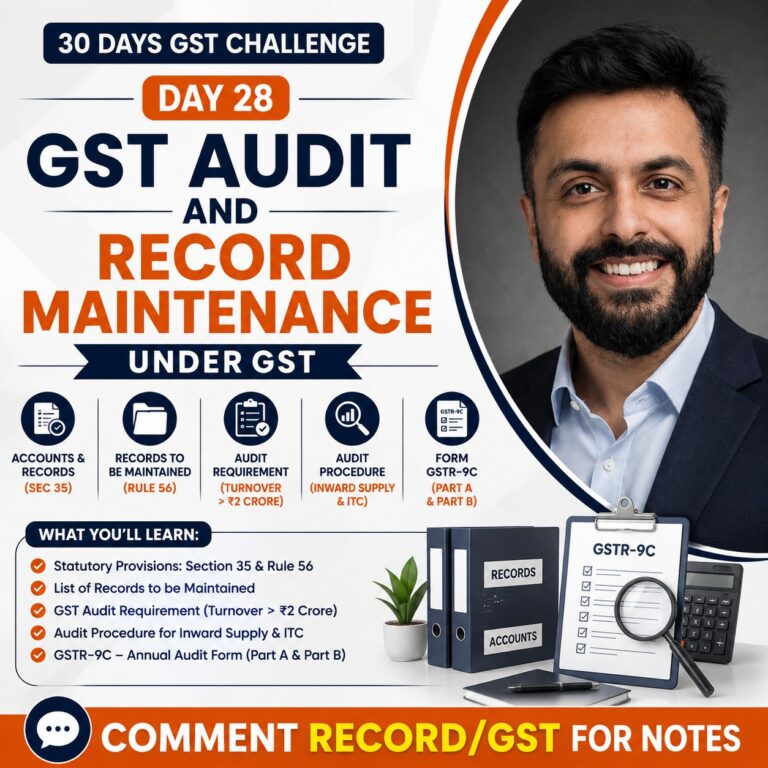
Accounts, Records & GST Audit
Section 35 & Rule 56 — What records to maintain, where, and for how long. Audit requirement for Turnover >₹2 Cr. Complete Audit Procedure for Inward Supply & ITC. And Form GSTR-9C — the Annual Audit Form — Part A & Part B decoded.

Comment ‘RECORD’ on Instagram for full notes → @cadeveshthakur.official
📲 Follow @cadeveshthakur.official for daily GST updates!
Part A — Accounts & Records: Section 35 & Rule 56
Every GST-registered taxpayer is legally required to maintain proper books of accounts and records. Section 35 lays down the obligation; Rule 56 specifies what exactly needs to be maintained.
List of Records to Maintain (Rule 56)
Rule 56 prescribes a specific list of records every registered taxpayer must maintain. These are checked during GST Audit:
📌 Key Rule — Separate Records per Activity
If a business is involved in multiple activities (e.g., manufacturing + trading + services), separate accounts must be maintained for each activity. Mixing records across activities is a common compliance gap picked up during GST audit.
Audit Requirement — Who Needs GST Audit?
Audit Procedure — Inward Supply & ITC
The note shows a detailed audit procedure specifically for Inward Supply and Input Tax Credit — this is the most critical area of any GST audit. Here is the step-by-step process:
Check each purchase — is the item/service eligible for ITC? Blocked credits under Section 17(5) must be identified and excluded (vehicles, food, personal expenses etc.)
Identify supplies attracting Reverse Charge Mechanism (RCM). Verify that RCM tax was paid via Electronic Cash Ledger (not ITC) and then claimed back as ITC.
Cross-check the Purchase Register with actual invoices. Ensure GSTIN, invoice number, date, taxable value and tax amounts match exactly — these are also verified against GSTR-2B.
Identify cases where goods were partially received (short receipt), destroyed in transit, or rejected and returned. ITC must be proportionately reversed in these situations.
- Short receipt → Partial ITC reversal
- Destroyed goods → Full ITC reversal
- Rejected goods → ITC reversal on rejected portion
Verify all Credit Notes received from suppliers — corresponding ITC must be reversed. Common gap: ITC reversed in wrong period or not reversed at all.
For taxpayers with both taxable and exempt supplies, ITC must be reversed proportionately under Rule 42 (inputs/input services) and Rule 43 (capital goods). Auditor verifies the computation.
Verify that no ITC has been availed on blocked items — motor vehicles, food & beverages, health services, club memberships, works contract for civil structures, etc. & MORE.
Form GSTR-9C — Annual Audit Form
GSTR-9C is the Reconciliation Statement and Audit Report to be filed along with GSTR-9 by taxpayers with turnover exceeding ₹2 Crore. It is certified by a CA or CMA.
| Part | What It Contains | Key Detail |
|---|---|---|
| Part A | Reconciliation Statement | Basic Details + 4 reconciliations below |
| A.1 — Turnover Reco. | Audited Financial Statements vs GSTR-9 | Turnover per FS vs turnover declared in GSTR-9 |
| A.2 — Tax Paid Reco. | Rate-wise tax liability vs GSTR-9 | CGST/SGST/IGST rate-wise reconciliation |
| A.3 — ITC Reco. | Audited FS vs GSTR-9 | ITC availed per FS vs ITC claimed in GSTR-9 |
| A.4 — Additional Liability | Auditor’s Recommendation on Non-Reconciled amounts | Any unreconciled difference → Additional tax due |
| A.5 — Instructions | Notification No. 49/2018 — CT & 74/2018-CT | Statutory instructions per CBIC notifications |
| Part B | Certification | CA/CMA signs and certifies the reconciliation statement |
📌 GSTR-9C = GSTR-9 + Reconciliation + CA/CMA Certificate
Think of GSTR-9C as the audit report layer on top of GSTR-9. GSTR-9 is filed by the taxpayer; GSTR-9C is certified by the CA/CMA and reconciles the return data with the audited financial statements. Any unreconciled difference results in additional liability which must be paid.
Why Reco. of Turnover?
Revenue in P&L includes items like sale of assets, advances, TDS deducted — which may or may not attract GST. Reconciliation isolates the correct taxable turnover.
Why Reco. of Tax Paid?
Rate-wise tax in GSTR-9 must match rate-wise tax in the audited accounts. Any mismatch suggests wrong rate applied during the year — requires additional payment.
Why Reco. of ITC?
ITC per books vs ITC per GSTR-9 must match. Excess ITC in books not reversed in GSTR-9 = additional liability. Short ITC in GSTR-9 = missed credit opportunity.
Part B — CA Certification
The CA/CMA certifies that the reconciliation is true and correct to the best of their knowledge. Professional responsibility — not just a signature.
Day 28 — Key Takeaways
📌 Quick Recall — Accounts, Records & Audit
- Sec 35: Records at principal place + each additional place of business
- Rule 56: Separate records for each activity — manufacturing, trading, services
- 6 Records to maintain: Inward, Outward, Job Work, Stock, Related Party, Returns
- Audit: Turnover > ₹2 Cr → Mandatory → By CA/CMA → Filed in GSTR-9C
- Audit Focus Areas: ITC eligibility, RCM, Purchase Register verification, Pro-rata (Rule 42/43), Credit Notes, Blocked Credits (Sec 17(5))
- GSTR-9C Part A: 4 reconciliations — Turnover, Tax Paid, ITC, Additional Liability
- GSTR-9C Part B: CA/CMA Certification
💬 Save the Reel & Comment ‘RECORD’
Save the reel for later and comment ‘RECORD’ to know in detail. Follow @cadeveshthakur.official — only 2 days left of the #30DaysGSTChallenge!