
1. Introduction: The Exporter’s Administrative Nightmare
For M/S Prime Perfumery Works, a successful export year was nearly erased not by market fluctuations or supply chain disruptions, but by a missing piece of paper. This Bengaluru-based partnership firm, represented by its partner Sri Mohammed Nasrulla Shariff, found itself entangled in a high-stakes liquidity crunch when its Integrated Goods and Services Tax (IGST) refund claims for the 2022-23 period were summarily rejected.
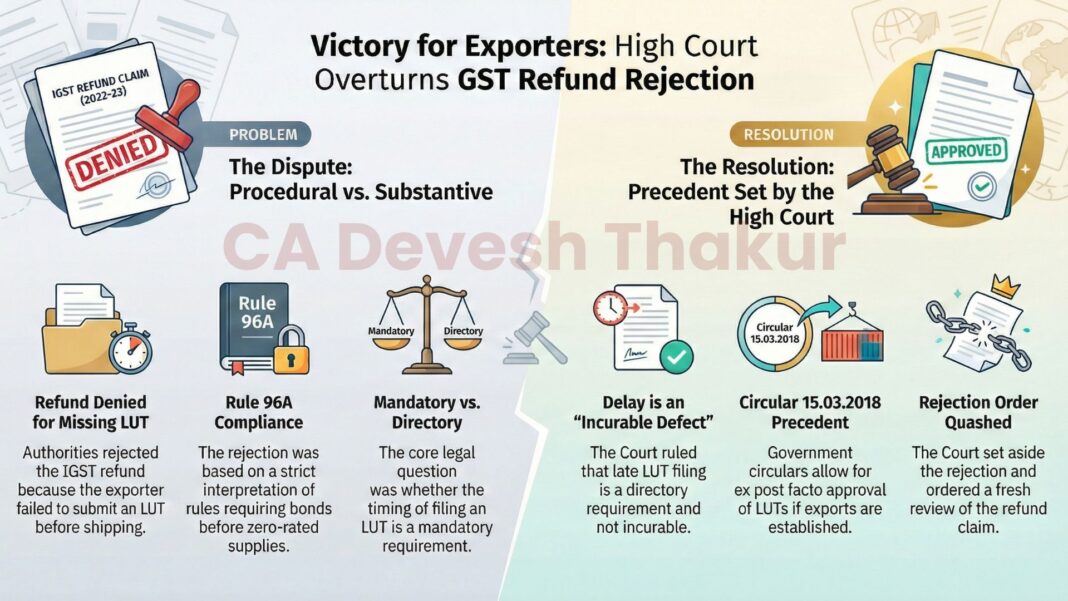
The bureaucratic machinery moved with punishing speed: a show cause notice was issued on December 28, 2023; the firm submitted its reply on January 11, 2024; and by January 31, 2024, the Assistant Commissioner had issued a final rejection order. The sole justification for this working capital strangulation was a procedural lapse—the petitioner had failed to furnish a Letter of Undertaking (LUT) or a Bond prior to the export of goods. The case, M/S Prime Perfumery Works vs. Assistant Commissioner of Central Tax (WP No. 11076 of 2024), recently brought before the High Court of Karnataka, serves as a landmark reminder that administrative rigidity must not be allowed to stifle substantive justice.
2. Substance Over Form: The “Directory” Nature of Procedures
At the heart of this litigation was a fundamental question of tax jurisprudence: is the timing of a procedural filing a mandatory “deal-breaker,” or is it merely directory? The Assistant Commissioner’s rejection was technically anchored in Rule 19(A) of the CGST Rules, asserting that the absence of a prior LUT was a fatal flaw. However, this interpretation ignores the commercial reality of export operations.
While Rule 96-A dictates the protocol for exports under LUT, the High Court adopted a pragmatic stance, distinguishing between “mandatory” requirements and “directory” procedures. In this context, the LUT serves as a revenue protection measure; however, when the “truth of the transaction”—the actual export of goods—is indisputable, the absence of the “form” poses no actual risk to the exchequer. The court reaffirmed that procedural requirements exist to facilitate the law, not to act as a trap for the unwary. As underscored by the 15.03.2018 Circular:
“It is emphasised that the substantive benefits of zero rating may not be denied where it has been established that exports in terms of the relevant provisions have been made.”
3. The Power of the Circular: Ignorance is Not Bliss for Tax Officials
A critical failure in the lower authority’s decision was the total disregard for Circular No. 349/47/2017-GST (dated 15.03.2018). In the realm of Indian tax law, Central Board of Indirect Taxes and Customs (CBIC) circulars are not merely “suggestions”—they are binding on the department to ensure administrative consistency.
The Assistant Commissioner’s failure to apply this circular represents a significant breach of the Principles of Natural Justice. The Board had explicitly clarified that zero-rated supplies might occasionally be made before an LUT is filed and provided for the condonation of such delays. By ignoring this binding guidance, the tax authority acted in contravention of established administrative law, forcing a taxpayer into unnecessary and costly litigation to claim a refund that was rightfully theirs.
4. The “Ex Post Facto” Lifeline
Faced with this administrative overreach, the High Court exercised its extraordinary jurisdiction, issuing a Writ of Certiorari to quash the flawed rejection order. The court introduced a vital lifeline: ex post facto approval. This concept allows for equitable administrative relief, recognizing that a requirement missed in the heat of business operations can be rectified after the fact without forfeiting substantive rights.
In a move that prioritizes fairness over form, the court ordered a “reconsideration afresh” with the following specific directives:
- The refund rejection order dated January 31, 2024, was officially quashed.
- The matter was remitted back to the Assistant Commissioner for a de novo review of the 2022-23 refund application.
- The petitioner was granted the right to submit the LUT/Bond along with a formal application for the condonation of delay.
- The respondent must now evaluate the claim based on the factual evidence of export and the 2018 Circular.
5. Why “Mandatory” Isn’t Always Absolute
The Revenue’s defense rested on a strict, literalist reading of Rule 96-A, arguing that the “prior to export” condition was absolute. Justice S.R. Krishna Kumar, in his judgment dated December 2, 2025, dismantled this rigidity. The ruling clarifies that “mandatory” labels in tax statutes often become “directory” when they collide with the proven reality of a zero-rated supply.
The “hero” observation of the judgment, found in paragraph 6, provides a vital precedent for tax professionals:
“…non-furnishing/non-submission of LUT/Bond in terms of Rule 96-A of the CGST Rules is not an incurable defect nor can the same be said to be mandatory especially when the respondents themselves have permitted… [filing] even subsequent to export.”
This acknowledges that if the state has already created a mechanism to accept late filings, it cannot simultaneously argue that the timing is an “incurable” jurisdictional barrier.
6. Conclusion: A Precedent for Procedural Fairness
The decision in M/S Prime Perfumery Works is a significant victory for the “substantive benefits of zero rating” over the “timing of the paperwork.” It protects exporters from a brand of bureaucracy that values the checklist more than the commerce. By forcing the department to adhere to its own binding circulars, the Karnataka High Court has fortified the shield of procedural fairness for all taxpayers.
For the 2022-23 period and beyond, this ruling ensures that legitimate exporters will not have their liquidity held hostage by clerical delays. It signals a move toward a more mature tax administration—one that recognizes that the economic contribution of an export far outweighs the sequence of its documentation.
Final Thought: In an era of digital taxation, is it time for our administrative systems to prioritize the “truth of the transaction” over the “timing of the paperwork”?
| Writ Petition Number | Petitioner Name | Respondent(s) | Nature of Relief Sought | Order Date | Relevant Tax Period | Key Legal Provisions Cited | Court Decision/Outcome |
| WP No. 11076 of 2024 | M/S Prime Perfumery Works | Assistant Commissioner of Central Tax, South Division-3, Bengaluru; 2. Government of India, Ministry of Finance | Quashing the refund rejection order dated 31/01/2024 (Form GST RFD-06) and directing Respondent No. 1 to issue a refund sanction order. | 02/12/2025 | 2022-23 | Section 54 and Section 16(3) of the CGST Act; Rule 92, Rule 19(A), and Rule 96-A of the CGST Rules; Circular dated 15.03.2018 | Petition allowed. The court set aside the rejection order and remitted the matter for reconsideration, holding that the requirement to furnish a Bond/LUT prior to export is directory and delay can be condoned ex post facto as per Circular dated 15.03.2018. |
Connect with CA Devesh Thakur
Stay updated with structured Income Tax learning, section-wise breakdowns, practical insights, and regular tax updates across platforms: