Cash Flow Statement as per AS 3 – Easy Explanation
1. What is a Cash Flow Statement?
A Cash Flow Statement shows how cash and cash equivalents move in and out of a business during a period.
In simple words:
- Profit shows performance.
- Cash Flow shows real cash position.
A company can show profit and still have no cash. That’s why this statement is important.
2. Important Definitions (AS 3)
2.1 Cash
- Cash in hand
- Bank balance (demand deposits)
2.2 Cash Equivalents
Short-term investments that:
- Can be easily converted into cash
- Have very low risk
- Have maturity of 3 months or less
Example:
- 60-day bank deposit
- Treasury bills
These are used to meet short-term needs.
2.3 Cash Flow
- Inflow → Increase in cash
- Outflow → Decrease in cash
3. Why is Cash Flow Statement Important?
It helps to:
- Know whether business operations are generating cash
- Check whether company can pay loans and dividends
- Understand liquidity and solvency
- Judge quality of earnings (Is profit real or just on paper?)
For CA students:
Operating Cash Flow > Net Profit = Good sign
Operating Cash Flow < Net Profit = Warning sign
4. Classification of Cash Flows (Very Important for Exams)
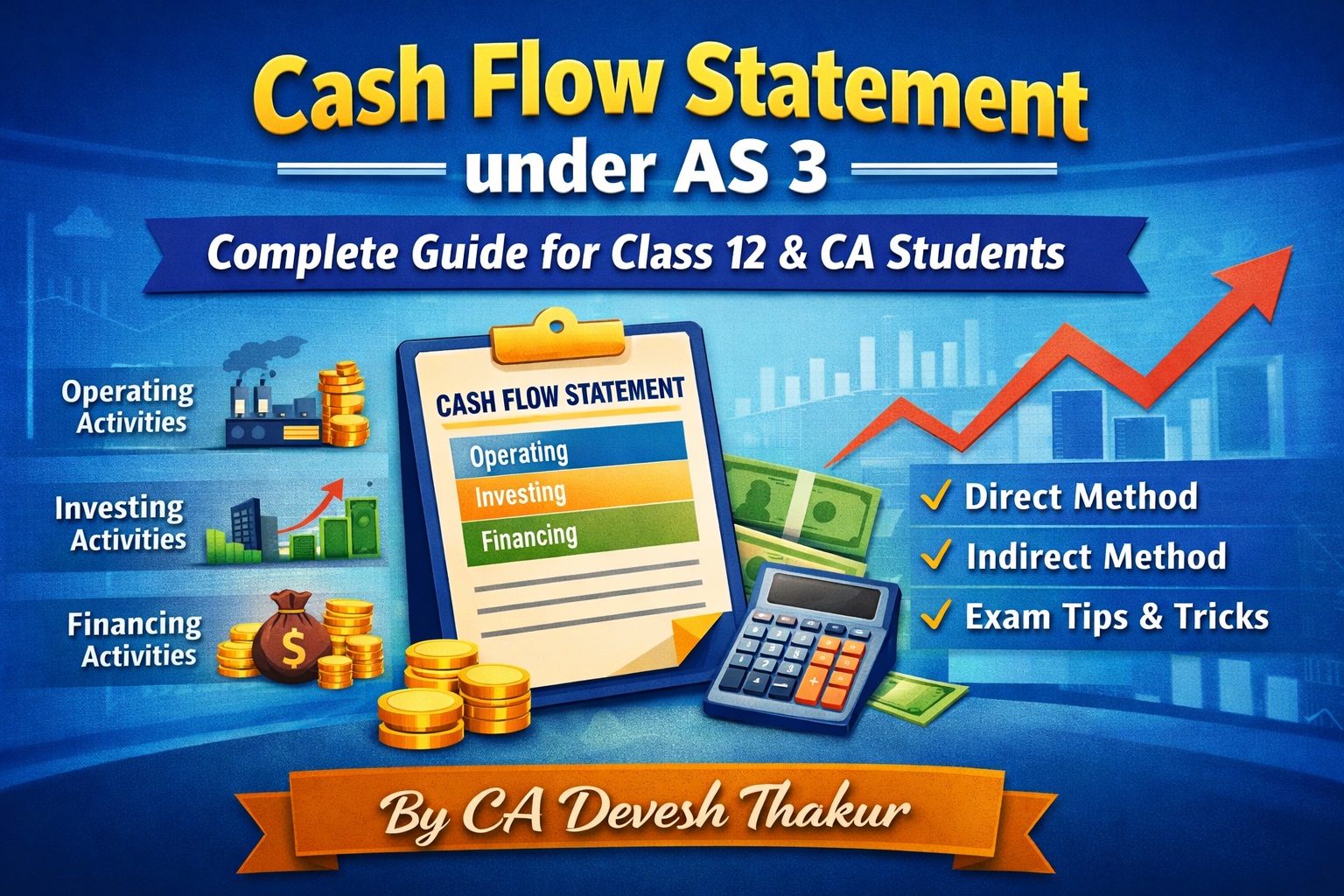
AS 3 divides cash flows into 3 categories:
- Operating Activities
- Investing Activities
- Financing Activities
Understand this properly — most exam mistakes happen here.
4.1 Operating Activities
Meaning:
These are the main business activities that generate revenue.
Think:
“What does the business do daily to earn money?”
Examples:
Cash Inflows
- Sale of goods
- Rendering services
- Commission, fees
- Insurance premium (for insurance companies)
Cash Outflows
- Payment to suppliers
- Payment to employees
- Income tax (if not related to investing/financing)
- Purchase of trading goods
Why Important?
It shows whether the core business is generating enough cash to:
- Continue operations
- Pay dividend
- Repay loans
For CA students:
This section reflects the sustainability of business.
Cash Flow Statement
for the year ended 31st March, 20X1 (₹ in lakhs)
| Particulars | Note | Amount (₹) |
| A. Cash Flow from Operating Activities | ||
| Profit before Tax | XXX | |
| Adjustments for: | ||
| Depreciation | XXX | |
| Loss on Sale of Assets | XXX | |
| Profit on Sale of Investments | (XXX) | |
| Interest Income | (XXX) | |
| Interest Expense | XXX | |
| Operating Profit before Working Capital Changes | XXX | |
| Adjustments for Changes in Working Capital: | ||
| Increase / (Decrease) in Working Capital | XXX | |
| Cash Generated from Operations | XXX | |
| Income Tax Paid | (XXX) | |
| Net Cash from / (Used in) Operating Activities (A) | XXX | |
| B. Cash Flow from Investing Activities | ||
| Sale of Fixed Assets | XXX | |
| Sale of Investments | XXX | |
| Capital Grant Received | XXX | |
| Interest Income Received | XXX | |
| Purchase of Fixed Assets | (XXX) | |
| Investment in Joint Venture | (XXX) | |
| Expenditure on Capital Work-in-Progress | (XXX) | |
| Net Cash from / (Used in) Investing Activities (B) | XXX | |
| C. Cash Flow from Financing Activities | ||
| Proceeds from Calls in Arrear | XXX | |
| Proceeds from Long-term Borrowings | XXX | |
| Proceeds from Short-term Borrowings | XXX | |
| Interest Paid | (XXX) | |
| Dividend Paid (including tax) | (XXX) | |
| Net Cash from / (Used in) Financing Activities (C) | XXX | |
| Net Increase / (Decrease) in Cash & Cash Equivalents (A+B+C) | XXX | |
| Cash & Cash Equivalents at the Beginning of the Year | XXX | |
| Cash & Cash Equivalents at the End of the Year | XXX |
4.2 Investing Activities
Meaning:
These relate to purchase or sale of long-term assets and investments.
Think:
“Where is company investing its money for future growth?”
Examples:
Cash Inflows
- Sale of land, building, machinery
- Sale of investments
- Loan repayment received from others
Cash Outflows
- Purchase of machinery, building
- Purchase of shares/debentures
- Loans given to others
Why Important?
It shows how much the company is investing for future income.
If company is investing heavily → may be growth phase
If company is selling assets regularly → may indicate financial stress
4.3 Financing Activities
Meaning:
These relate to changes in capital and borrowings.
Think:
“From where company is raising money?”
Examples:
Cash Inflows
- Issue of shares
- Issue of debentures
- Loan taken
Cash Outflows
- Loan repayment
- Dividend payment
- Redemption of shares
Why Important?
It shows:
- How company is funded
- Future obligations to investors and lenders
5. Methods to Calculate Operating Cash Flow
AS 3 allows two methods:
- Direct Method
- Indirect Method
Both give same final answer — only presentation differs.
5.1 Direct Method
Here we directly show:
Cash received from customers
Less: Cash paid to suppliers
Less: Cash paid to employees
= Net Cash from Operating Activities
Advantage:
- Better for forecasting
- Clear understanding of cash receipts and payments
Reality:
Rarely used in practice.
5.2 Indirect Method (Most Important for Exams)
Starts from:
Net Profit
Then adjust:
Step 1: Add Non-Cash Expenses
- Depreciation
- Amortisation
- Goodwill written off
Step 2: Remove Non-Operating Items
- Profit on sale of asset (subtract)
- Loss on sale of asset (add)
Step 3: Adjust Working Capital
- Increase in Current Assets → Subtract
- Decrease in Current Assets → Add
- Increase in Current Liabilities → Add
- Decrease in Current Liabilities → Subtract
Final result = Net Cash from Operating Activities
Limitation:
Does not show detailed cash receipts and payments.
6. Special Points (Exam-Oriented)
6.1 Interest and Dividend
Dividend Paid → Financing Outflow
Dividend Received → Investing Inflow
Interest classification may vary depending on nature of business.
6.2 Income Tax
Generally treated as Operating
Unless specifically related to investing or financing activity.
6.3 Insurance Claim
If fixed asset destroyed by fire:
Insurance claim received → Investing Inflow
6.4 Movements Within Cash
If:
Cash deposited into bank
Or bank FD made for 2 months
This is NOT a cash flow.
Why?
Because cash is simply moved within cash equivalents.
7. Key Difference Between Operating, Investing & Financing
| Activity Type | Focus | Question to Ask |
| Operating | Core Business | Is business generating cash? |
| Investing | Assets & Growth | Where is company investing money? |
| Financing | Capital Structure | From where company raised funds? |
Final Understanding (Concept Link)
Operating = Survival
Investing = Growth
Financing = Funding
If:
Operating cash is strong → Business is healthy
Only financing cash is strong → Business is dependent on loans
Selling assets to survive → Dangerous signal
One-Line Summary for Exams
Cash Flow Statement as per AS 3 shows movement of cash under Operating, Investing and Financing activities to assess liquidity, solvency and quality of earnings.