

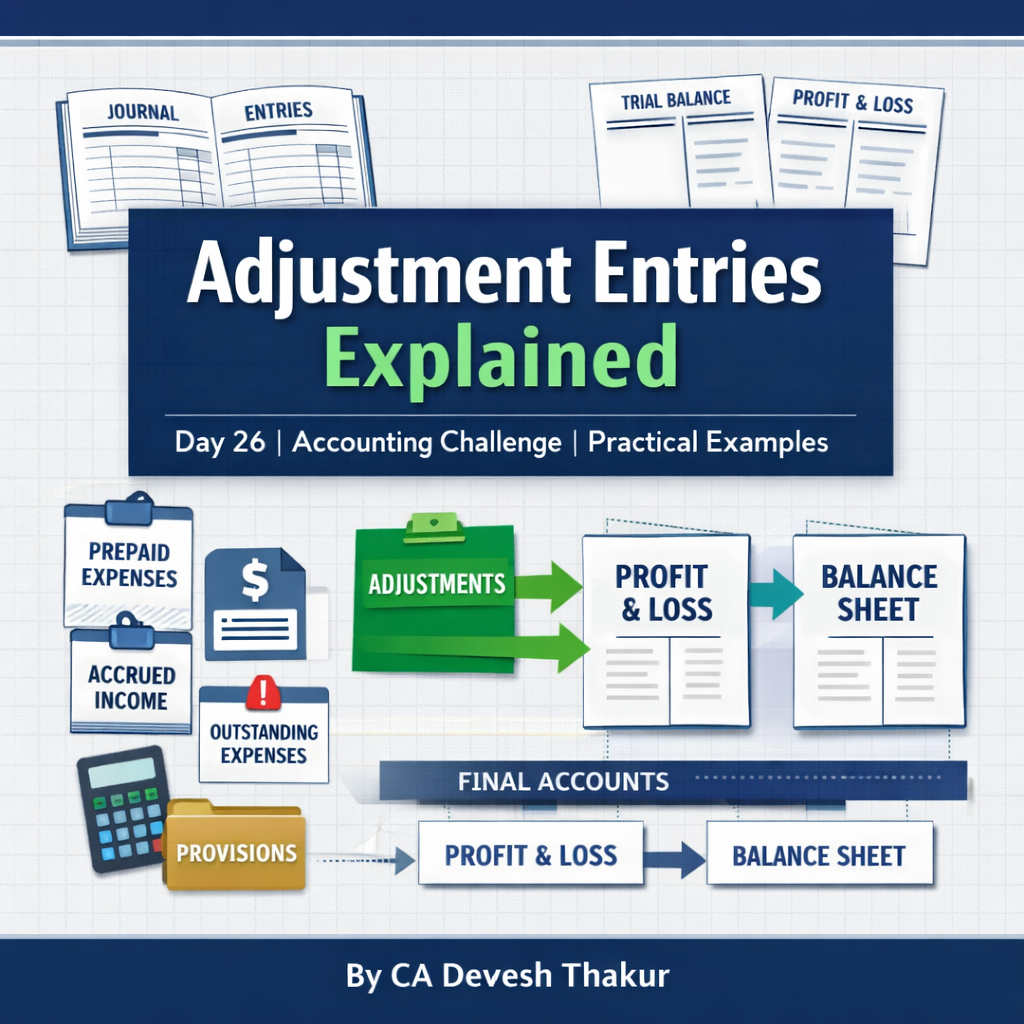
Day 26: Adjustment Entries in Accounting – Meaning, Purpose, Rules, Entries, Examples & Comparison Chart
Introduction: Why Adjustment Entries Matter in Accounting
Many students believe that cash received = income and cash paid = expense.
This is the biggest accounting mistake — and the main reason profits go wrong in exams and real life.
Adjustment entries exist to correct this mistake.
👉 Accounting follows the accrual concept, not the cash concept.
👉 Profit must reflect the correct period, not cash movement.
In Day 26 of the 50 Days Accounting Challenge, we cover Adjustment Entries in a complete, exam-oriented and practical way.
What Are Adjustment Entries?
Adjustment entries are journal entries passed after preparing the Trial Balance but before finalising the accounts, to ensure:
- Correct profit or loss
- Correct assets and liabilities
- Income and expenses are recorded in the right accounting period
In simple words:
Adjustment entries correct incomplete or incorrect information in the Trial Balance.
Purpose of Passing Adjustment Entries
Adjustment entries are passed to:
- Record outstanding and prepaid expenses
- Record accrued and advance incomes
- Account for non-cash expenses like depreciation
- Adjust owner-related items like interest on capital
- Show the true financial position of the business
Without adjustment entries:
❌ Profit will be wrong
❌ Balance Sheet will be misleading
Types of Adjustment Entries (Day 26 Coverage)
This blog covers the following six adjustment entries:
- Outstanding Expenses
- Prepaid Expenses
- Accrued Income
- Income Received in Advance
- Interest on Capital
- Depreciation
Each is explained below in detail.
1. Outstanding Expenses
Meaning
Outstanding expenses are expenses incurred during the accounting year but not yet paid.
Why Adjustment Is Required
Expense belongs to the current year, but payment is pending.
If not adjusted, profit will be overstated.
Accounting Rule
- Debit the expense
- Credit the liability
Journal Entry
Expense A/c Dr
To Outstanding Expense A/c
Impact
- Profit & Loss Account → Expense increases → Profit decreases
- Balance Sheet → Outstanding expense shown as a liability
Example
Salary paid ₹20,000
Outstanding salary ₹3,000
Correct salary expense = ₹23,000
2. Prepaid Expenses
Meaning
Prepaid expenses are expenses paid in advance for a future period.
Why Adjustment Is Required
Payment relates partly to the next accounting year.
Current year profit is shown lower than actual.
Accounting Rule
- Debit the asset
- Credit the expense
Journal Entry
Prepaid Expense A/c Dr
To Expense A/c
Impact
- Profit & Loss Account → Expense decreases → Profit increases
- Balance Sheet → Prepaid expense shown as an asset
Example
Rent paid ₹12,000
Prepaid rent ₹2,000
Expense for current year = ₹10,000
3. Accrued Income (Income Earned but Not Received)
Meaning
Accrued income is income earned during the year but not yet received.
Why Adjustment Is Required
Income belongs to the current year but is missing from books.
Profit is understated.
Accounting Rule
- Debit the asset
- Credit the income
Journal Entry
Accrued Income A/c Dr
To Income A/c
Impact
- Profit & Loss Account → Income increases → Profit increases
- Balance Sheet → Accrued income shown as an asset
Example
Interest earned ₹5,000
Interest received ₹3,500
Accrued income = ₹1,500
4. Income Received in Advance
Meaning
Income received in advance is income received before it is earned.
Why Adjustment Is Required
Cash received does not belong to the current year.
Profit is overstated.
Accounting Rule
- Debit income
- Credit liability
Journal Entry
Income A/c Dr
To Unearned Income A/c
Impact
- Profit & Loss Account → Income decreases → Profit decreases
- Balance Sheet → Unearned income shown as a liability
Example
Rent received ₹10,000
Advance rent ₹2,000
Actual income = ₹8,000
5. Interest on Capital
Meaning
Interest on capital is the return given to the owner for investing capital in the business.
Why Adjustment Is Required
It is:
- Expense for business
- Income for owner
Hence adjustment is necessary.
Accounting Rule
- Debit expense
- Credit capital
Journal Entry
Interest on Capital A/c Dr
To Capital A/c
Impact
- Profit & Loss Account → Expense increases → Profit decreases
- Balance Sheet → Capital increases
Example
Capital ₹1,00,000
Interest @10% = ₹10,000
6. Depreciation
Meaning
Depreciation is the reduction in value of an asset due to use, time, or wear and tear.
Why Adjustment Is Required
Asset has been used to earn income.
Expense must be matched with revenue.
Accounting Rule
- Debit depreciation (expense)
- Credit asset
Journal Entry
Depreciation A/c Dr
To Asset A/c
Impact
- Profit & Loss Account → Expense increases → Profit decreases
- Balance Sheet → Asset value decreases
Example
Furniture ₹50,000
Depreciation @10% = ₹5,000
Closing value = ₹45,000
Comparison Chart: Key Adjustment Entries
| Particulars | Outstanding | Prepaid | Accrued Income | Income in Advance |
| Nature | Expense | Expense | Income | Income |
| Cash Status | Not paid | Paid | Not received | Received |
| P&L Impact | Profit ↓ | Profit ↑ | Profit ↑ | Profit ↓ |
| Balance Sheet | Liability | Asset | Asset | Liability |
Key Exam-Oriented Takeaways
- Adjustment entries follow accrual concept
- Cash movement is irrelevant
- Always ask:
👉 Does it belong to the current year? - Every adjustment affects:
- P&L Account
- Balance Sheet
Final Summary
Adjustment entries ensure that:
- Profit is correct
- Assets and liabilities are accurate
- Financial statements reflect true and fair view
Adjustment entries are passed not for cash, but for correctness.