
Return Compliance in Form DRC-01B under GST: Complete Guide for Taxpayers & Professionals
Introduction
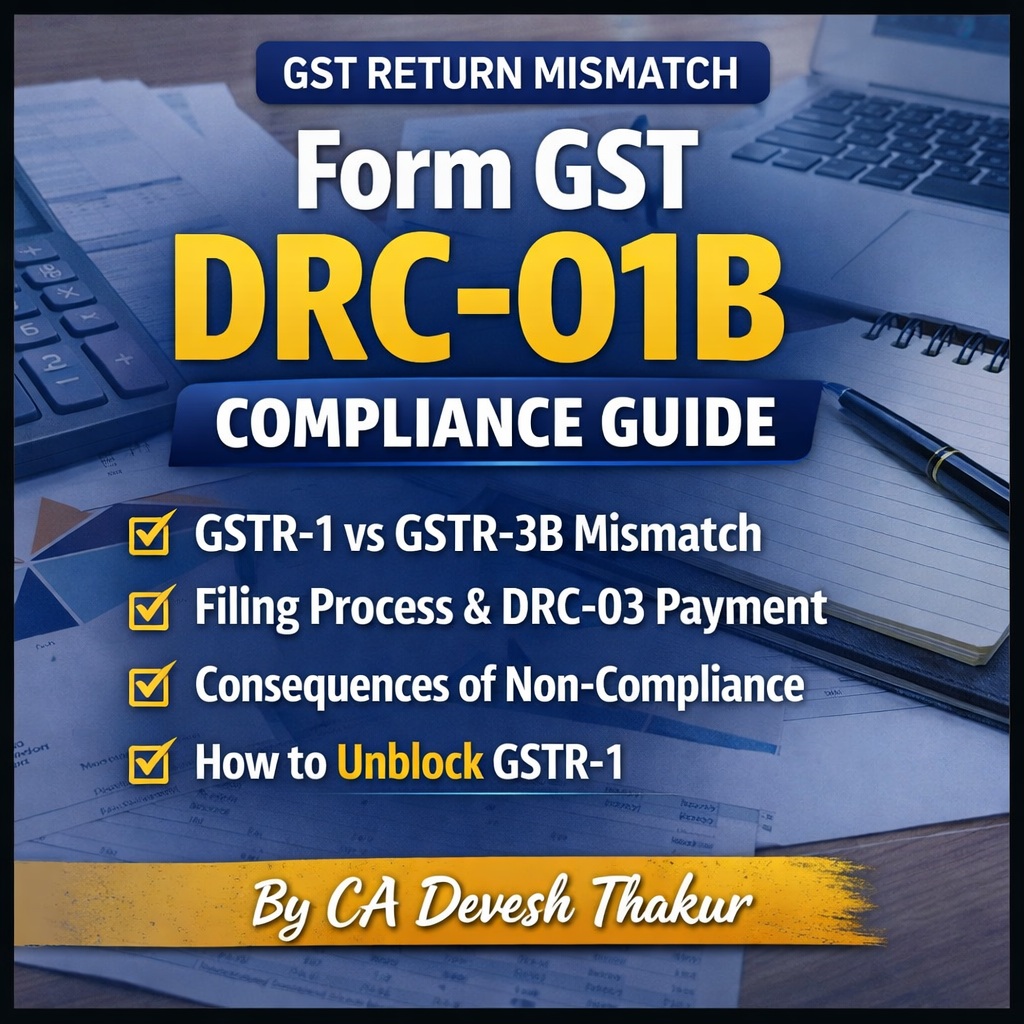
The GST compliance framework in India has evolved from manual scrutiny to system-driven, data-based enforcement. One of the most significant outcomes of this shift is Form GST DRC-01B, a compliance mechanism introduced to address mismatches between outward supply reporting and tax payment.
Many taxpayers mistakenly assume DRC-01B to be a routine notice. In reality, non-compliance can directly block GSTR-1/IFF filing, disrupting business operations and input tax credit flow for customers.
This article provides a complete, practical, and SEO-optimised explanation of Form DRC-01B, its applicability, filing process, consequences, and best practices — strictly based on the official GSTN FAQs and user manual .
What is Form GST DRC-01B?
Form GST DRC-01B is a system-generated intimation issued when there is a difference in GST liability between:
- GSTR-1 / IFF (statement of outward supplies), and
- GSTR-3B / 3BQ (summary return for tax payment)
If the tax liability reported in GSTR-1 exceeds the tax actually paid through GSTR-3B beyond a pre-defined system threshold, the GST portal automatically generates DRC-01B Part A and requires the taxpayer to submit a reply in Part B .
Why Was DRC-01B Introduced?
The core objective of DRC-01B is real-time return reconciliation. It ensures that:
- Tax reported to the system is actually paid
- Artificial inflation of outward supplies is detected early
- Revenue leakage is prevented without immediate adjudication
Instead of initiating direct demand proceedings, the system first gives the taxpayer an opportunity to pay the difference or explain it.
When is Form DRC-01B Triggered?
Form DRC-01B is triggered automatically when:
- Liability declared in GSTR-1/IFF
exceeds - Liability paid in GSTR-3B/3BQ, and
- The difference crosses either:
- A fixed value limit, or
- A configurable percentage threshold
No officer intervention is required. The entire process is system-driven .
Applicability: Who Needs to Comply?
Form DRC-01B applies to a wide category of taxpayers, including:
- Regular GST taxpayers
- SEZ units and SEZ developers
- Casual taxable persons
- Composition taxpayers (including those opting in or out)
If you file GSTR-1 and GSTR-3B, this compliance mechanism applies to you.
Monthly vs Quarterly Filers (QRMP Scheme)
The frequency of DRC-01B generation depends on GSTR-3B filing:
- Monthly filers → DRC-01B generated monthly
- QRMP filers → DRC-01B generated after quarterly GSTR-3B filing
Accordingly, Part B must be filed monthly or quarterly, as applicable .
How Will You Know DRC-01B Has Been Issued?
Once Form DRC-01B Part A is generated:
- A Reference Number (ARN) is assigned
- Intimation is sent via registered email and SMS
- The notice is also available on the GST portal
Navigation path on GST portal:
Services → Returns → Return Compliance → Liability Mismatch (DRC-01B)
Structure of Form GST DRC-01B
Part A – Intimation of Difference (System Generated)
Part A displays:
- Liability as per GSTR-1/IFF
- Liability as per GSTR-3B
- Tax-wise breakup (IGST, CGST, SGST/UTGST, Cess)
- Differential amount and legal reference
This part is read-only and can be downloaded as a PDF .
Part B – Reply by Taxpayer (Mandatory)
Part B is the compliance response and offers two independent options:
- Payment of differential tax through DRC-03, and/or
- Explanation for the difference in liability
A taxpayer may:
- Pay the difference,
- Explain the difference, or
- Do both, depending on the situation.
Option 1: Paying the Difference Using Form GST DRC-03
If the mismatch is genuine, payment must be made via Form GST DRC-03.
Key conditions:
- Cause of payment must be selected as
“Liability mismatch – GSTR-1 to GSTR-3B” - DRC-03 must be filed after issuance of DRC-01B
- The tax period must match the DRC-01B period
After payment:
- Enter the ARN of DRC-03
- Click Validate
The system verifies GSTIN, period, and cause of payment before accepting the ARN .
Option 2: Explaining the Reason for Difference
If the difference is due to timing or reporting reasons, taxpayers may provide an explanation instead of payment.
Common selectable reasons include:
- Excess liability already paid in earlier GSTR-3B
- Errors in GSTR-1 to be corrected in subsequent periods
- Timing differences due to amendments
- Incorrect reporting of advances
- Any other valid reason (with explanation)
Each selected reason must be explained (up to 500 characters).
Failure to provide explanation results in system error .
Step-by-Step Process to File Form DRC-01B Part B
Step 1: Login to GST Portal
Visit www.gst.gov.in and login using valid credentials.
Step 2: Navigate to Return Compliance
Go to:
Services → Returns → Return Compliance → Liability Mismatch (DRC-01B)
Step 3: View Pending Records
Click VIEW under the Liability Mismatch tile.
Search using reference number, return period, or status.
Step 4: Open the Reference Number
Click the reference number hyperlink to open the form.
Step 5: Fill Part B
- Enter DRC-03 ARN (if payment made), and/or
- Select reason(s) and provide explanation
Step 6: Save and File
- Tick declaration checkbox
- Select authorized signatory
- Enter place
- Save and click FILE GST DRC-01B
Step 7: OTP Authentication
File using EVC or DSC, enter OTP, and verify.
Step 8: Confirmation
A success message appears and status changes to Completed.
Final PDF can be downloaded .
What Happens If DRC-01B Is Not Filed?
Failure to file Part B has serious consequences:
- GSTR-1 / IFF filing gets blocked for the next period
- Outward supplies cannot be reported
- Buyer input tax credit may be affected
- Business operations face disruption
The block is system-driven and automatic .
Common Errors to Avoid
- Entering incorrect DRC-03 ARN
- Selecting wrong cause of payment
- Mismatch in tax period
- Selecting reasons without explanation
- Ignoring pending DRC-01B notices
Most filing failures occur due to procedural negligence, not system issues.
Best Practices for GST Compliance
- Reconcile GSTR-1 and GSTR-3B before filing
- Track amendments and advances accurately
- Avoid over-reporting in GSTR-1 without tax payment
- Address DRC-01B notices immediately
Preventive reconciliation is far easier than corrective compliance.
Conclusion
Form GST DRC-01B represents a shift from reactive enforcement to proactive compliance monitoring under GST. While it is not a demand notice, it carries significant operational consequences if ignored.
Timely filing of DRC-01B Part B — with either payment or proper explanation — ensures uninterrupted return filing and protects businesses from unnecessary compliance risks.
Understanding and managing this form correctly is now an essential part of GST return compliance.