
GSTR-1 Table-Wise Details Explained: A Complete Guide for Businesses (Updated 2026)
Every registered business under GST must file GSTR-1, a monthly or quarterly return that contains the details of all outward supplies. This return forms the foundation for the entire GST compliance system because the details filed here auto-populate in the recipient’s GSTR-2A, GSTR-2B, and eventually affect ITC availability, tax liability, and reconciliation.
However, many taxpayers struggle to understand the multiple tables and categories in GSTR-1. Each table has a specific purpose, and choosing the wrong table can lead to mismatches, notices, penalties, or delayed refunds.
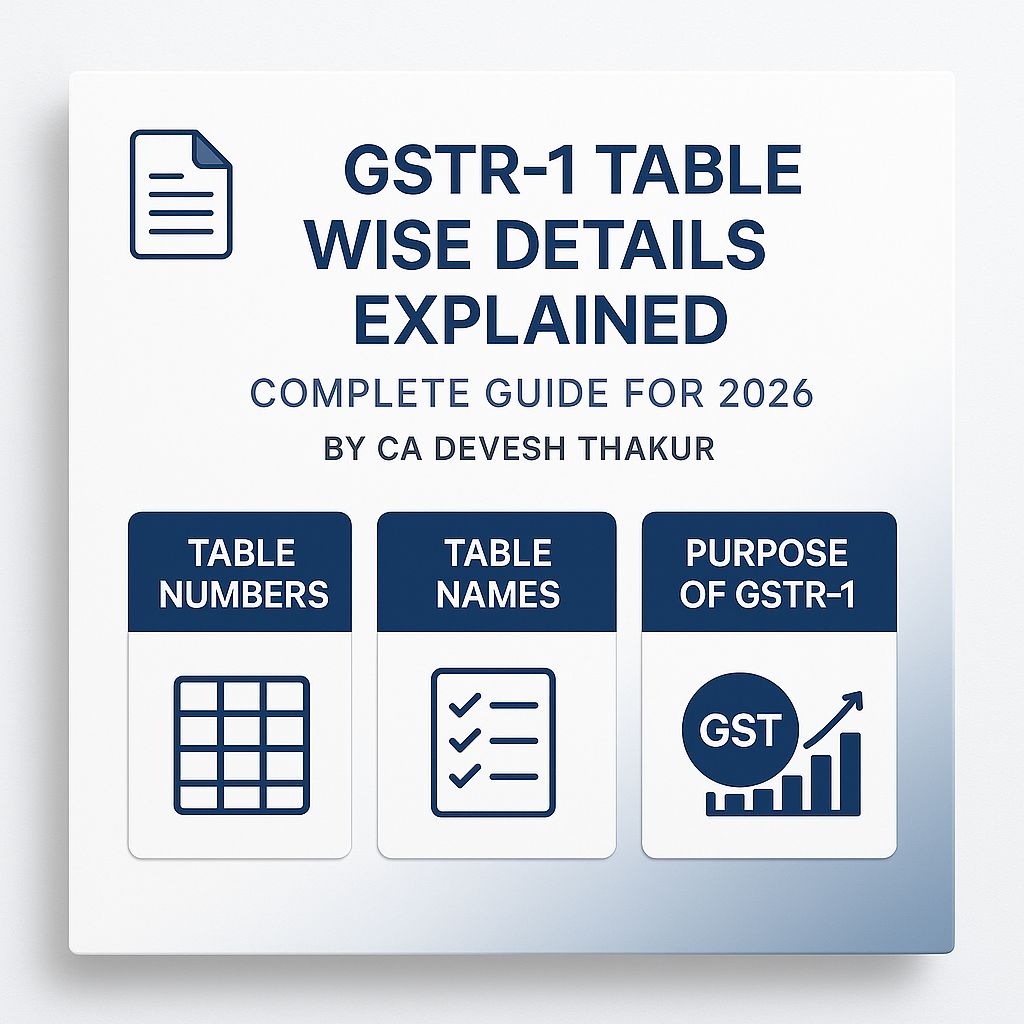
In this blog, we break down each table of GSTR-1 in simple modern English. You will learn:
- Table No.
- Table Name / Particular
- Purpose of that table
- When it should be used
- What data should NOT be entered
- Practical examples
What is GSTR-1?
GSTR-1 is a monthly/quarterly GST return that reports all outward supplies of goods and services, including:
- Sales
- Exports
- E-commerce supplies
- Deemed exports
- Credit/Debit notes
- Advance receipts
- Amendments to earlier returns
In simple words, GSTR-1 is your sales report under the GST law.
Why GSTR-1 is Important
GSTR-1 plays a crucial role because:
- It auto-populates GSTR-2A & GSTR-2B for buyers
- It impacts buyer’s Input Tax Credit (ITC)
- It helps the government track your outward supplies
- It forms the basis for GSTR-3B liability
- It helps avoid mismatch notices
- It enables smooth e-invoicing and e-way bill data flow
Incorrect GSTR-1 = ITC mismatch + notices from GST department.
Table-Wise Detailed Explanation of GSTR-1
Below is the table-wise breakdown of GSTR-1, based on the structure seen in your uploaded GSTR-1 extract .
Table 4A – B2B Supplies (Registered Persons – Regular)
This table includes:
- All invoices issued to Registered Buyers
- Supplies attracting normal GST
- Supplies made via e-commerce operator (normal category)
Purpose:
To report all taxable outward supplies made to GST-registered recipients.
Include:
- Invoices to registered buyers
- Supplies to composition dealers (yes, they are registered)
- E-commerce sales where TCS is collected
Do Not Include:
- Reverse-charge invoices
- Nil/exempt supplies
Table 4B – Supplies Attracting Reverse Charge (RCM)
This table records supplies made by you where the buyer is liable to pay GST under RCM.
Purpose:
To disclose outward supplies where tax is paid by the recipient, not the supplier.
Examples:
- Legal services
- Security services
- GTA services (transport)
Table 5 – B2CL (Inter-State Supplies to Unregistered Persons > ₹1 lakh)
If an unregistered buyer purchases goods/services worth more than ₹1,00,000 (inter-state), report it here.
Purpose:
To capture large inter-state unregistered supplies separately.
Table 6A – Export Sales (With/Without Payment of Tax)
Exports are treated as zero-rated supplies.
Purpose:
To report export invoices under:
- LUT/Bond (without payment of IGST)
- Payment of IGST to claim refund
Include:
- Direct export
- Merchant export
Table 6B – Supplies to SEZ Units/Developers
SEZ supplies are zero-rated.
Purpose:
To declare supplies to SEZ under:
- With IGST
- Without IGST (LUT)
Important:
You need SEZ endorsement for validity.
Table 6C – Deemed Exports
Though goods do not leave India, these are treated as “deemed exports.”
Examples:
- Supplies to EOU
- Advance authorization holders
- EPCG license holders
Table 7 – B2C (Others) – Summary of Small Unregistered Sales
This is one of the biggest tables for retail sellers.
Purpose:
To capture small supplies made to unregistered consumers.
Include:
- Local retail sales
- Cash sales
- Low-value e-commerce orders
Table 8 – Nil-Rated, Exempt & Non-GST Supplies
Purpose:
To report supplies where no GST applies.
Examples:
- Fresh fruits/vegetables (nil)
- Education services (exempt)
- Petrol, alcohol (non-GST)
Table 9A – Amendments to Earlier Period Invoices
If you made mistakes in previous months, correct them here.
Purpose:
To revise B2B, B2CL, Export, SEZ, and Deemed Export invoices.
Table 9B – Credit/Debit Notes Issued (Registered Recipients)
This table includes:
- Credit notes
- Debit notes
Purpose:
To adjust taxable value/tax amount with registered buyers.
Table 9B (Unregistered) – CDNUR
Purpose:
To declare credit/debit notes for B2C transactions.
Table 9C – Amendments to Credit/Debit Notes
Purpose:
If credit/debit notes were wrongly reported earlier, amend them here.
Table 10 – Amendments to B2C Small Supplies (Table 7)
Correcting earlier reported small B2C supplies.
Table 11A – Advances Received (No Invoice Issued Yet)
Under GST, advances for services must be taxed.
Purpose:
To report tax liability on advances received but invoice not yet issued.
Table 11B – Adjustments of Advances from Earlier Periods
Purpose:
When invoice is issued later, the advance is adjusted and reported here.
Table 12 – HSN Wise Summary of Outward Supplies
Your uploaded GSTR-1 includes the HSN summary on page 4 with 3 HSN entries.
This is a mandatory requirement.
Purpose:
To provide a consolidated HSN-wise summary for government analytics.
Table 13 – Documents Issued Summary
This table shows the total documents issued like:
- Tax invoices
- Debit notes
- Credit notes
- Refund vouchers
- Delivery challans
Table 14 – Supplies via E-Commerce Operator
Your report shows supplies through e-commerce with tax liability under Section 52.
Purpose:
To disclose outward supplies made through platform like:
- Amazon
- Meesho
- Flipkart
- Swiggy/ Zomato
Table 15 – Supplies Under Section 9(5)
E-commerce platforms pay GST instead of suppliers.
Examples:
- House-keeping services
- Restaurant services (except big restaurants)
Practical Impact of Each GSTR-1 Table
Understanding each table is important because:
- Table 4A affects ITC of your buyers
- Table 7 affects your turnover reporting
- Table 12 is used for departmental risk analysis
- Table 9B affects credit note matching
- Table 14 affects e-commerce TCS reporting
Filing errors often lead to:
- GST mismatches
- Notices DRC-01A, DRC-01
- Wrong turnover in GSTR-3B
- ITC blockage for recipients
- Delay in export refunds
Common Mistakes in GSTR-1 (Avoid These)
✔ Entering B2C invoices in B2B tables
✔ Missing credit/debit notes
✔ Missing HSN code summary
✔ Wrong GSTIN of buyer
✔ Wrong POS (Place of Supply)
✔ Duplicate invoices
✔ Not reporting e-commerce TCS supplies
Tips to Ensure Error-Free GSTR-1 Filing
- Reconcile sales with books
- Match e-commerce reports
- Verify GSTINs before filing
- Ensure HSN codes match compliance rules
- Verify credit/debit notes
- Validate POS for inter-state supplies
- Use automation if your volume is high
Conclusion
GSTR-1 is a powerful return that governs the entire flow of GST compliance. When filed accurately table-wise, it ensures seamless ITC for customers, correct tax liabilities, and smooth business accounting.
Always remember:
Correct GSTR-1 = Strong GST Compliance + Happy Clients + Zero Notices
© Content by CA Devesh Thakur.
Reproduction or redistribution in any form is prohibited without prior written permission.