
Income Tax Act 2025 Explained: Why a New Law Was Needed? (Day 1)
Introduction: A New Beginning for India’s Tax Law
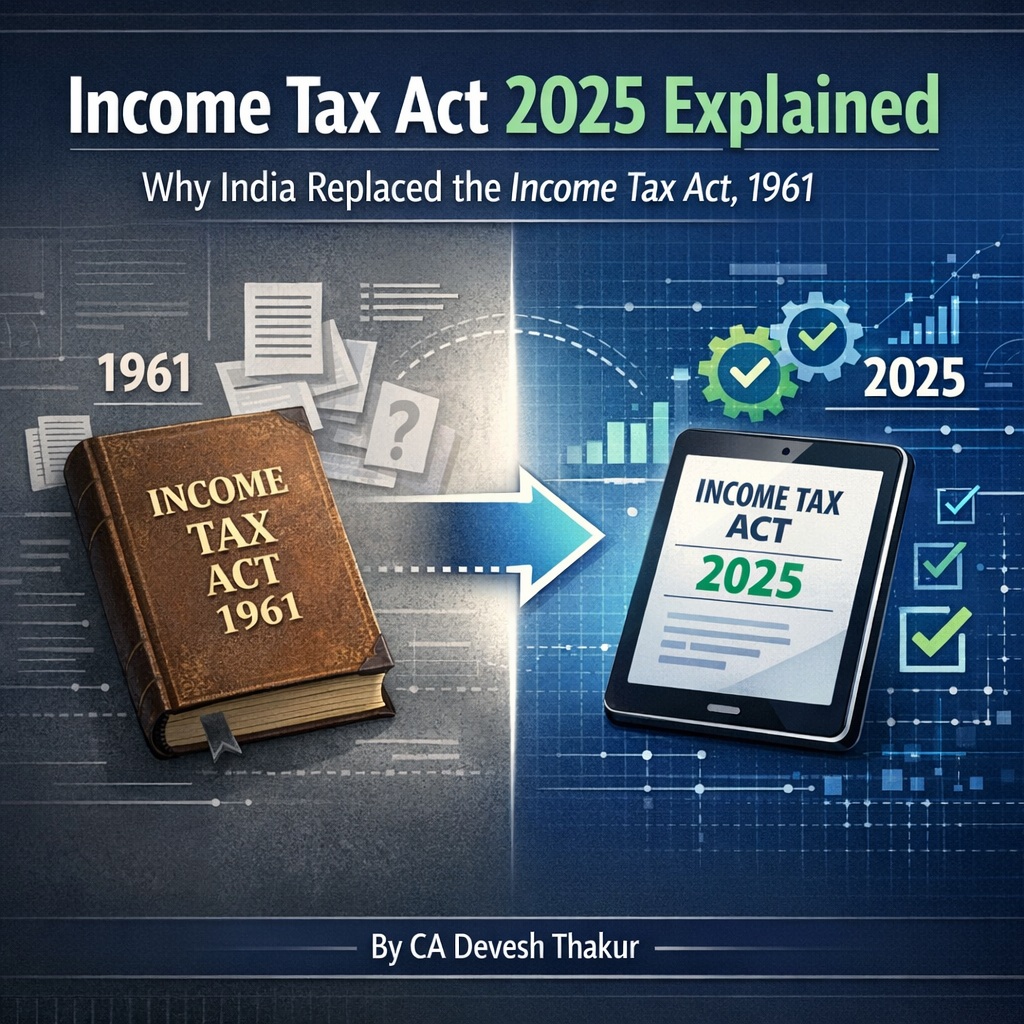
The Income Tax Act is not just a law for collecting taxes — it is the backbone of India’s fiscal system. For more than six decades, the Income Tax Act, 1961 governed how income was taxed, assessed, and administered in India. While the Act served the nation well, over time it became increasingly complex, bulky, and difficult to interpret.
To address these challenges, the Government of India introduced the Income Tax Act, 2025, with the objective of making tax law simpler, clearer, and more user-friendly, without altering tax rates or core policy principles.
This blog (Day 1 of the 15 Days Income Tax Act 2025 Series) explains why a new Act was required, what problems existed in the old law, and how the new Act seeks to solve them.
Background of the Income Tax Act, 1961
The existing Income Tax Act was:
- Passed in 1961
- Implemented from 1 April 1962
Since then, the Act has undergone:
- More than 65 Finance Acts
- Over 4,000 amendments
This continuous amendment process reflects the dynamic nature of taxation, which must adapt to:
- Changing economic conditions
- New business models
- Evolving income sources
- Government policy priorities
Unlike criminal or civil laws, tax law needs annual updates to remain relevant.
Why Did the Income Tax Act Become So Complex?
Despite its importance, the Income Tax Act, 1961 gradually became difficult to understand due to several reasons:
1. Accumulation of Amendments
Every year, new provisions were inserted to address emerging issues. However, old provisions that had outlived their purpose were often not removed.
2. Excessive Use of Provisos and Explanations
To clarify legislative intent or respond to court rulings:
- Over 1,200 provisos
- More than 900 explanations
were added.
As a result, a single rule was often scattered across:
- The main section
- Multiple provisos
- Several explanations
This made interpretation challenging for students, professionals, and taxpayers alike.
3. Complex Legal Drafting Style
Traditional legal language, lengthy sentences, and excessive cross-referencing made the Act bulky and intimidating, even for experienced practitioners.
Why Does the Income Tax Act Require Frequent Amendments?
The Income Tax Act is a dynamic legislation, meaning it must change with time. Some examples include:
- Incentives for exports (sections like 80HHC)
- Infrastructure development benefits (section 80-IA)
- Software and IT sector benefits (sections 10A, 10AA)
- Startup incentives (section 80-IAC)
While these provisions served their purpose, many remained in the statute even after becoming non-operative, adding to the law’s size and complexity.
Learning from Global Experiences
India studied international tax law simplification efforts before drafting the new Act:
- United Kingdom simplified language but ended up with multiple Acts
- Australia simplified drafting but increased overall volume
The key lesson was clear:
👉 True simplification requires not just simpler language, but a better structure.
Objective of the Income Tax Act, 2025
The Finance Minister clearly stated that the new law aims to make the Income Tax Act:
- Concise
- Lucid
- Easy to read and understand
The focus is not on changing tax policy, but on improving clarity and usability.
Key Structural Changes Introduced in Income Tax Act 2025
1. Removal of Redundant Provisions
Provisions that were no longer relevant or operational have been removed, reducing unnecessary clutter.
2. Elimination of Provisos and Explanations
Instead of provisos and explanations:
- Clear sub-sections
- Well-defined clauses
are used.
This improves readability and reduces interpretational disputes.
3. Extensive Use of Tables
The new Act uses tables extensively to present:
- TDS provisions
- Exemptions
- Formula-based calculations
This makes the law easier to understand at a glance.
4. Simplified Cross-Referencing
Complex references such as section, sub-section, clause, and sub-clause chains have been simplified, reducing confusion.
5. Removal of “Previous Year” and “Assessment Year” Confusion
The Act now relies only on the Financial Year, making compliance easier, especially for new taxpayers.
Improvement in Readability and Tax Certainty
The new Act:
- Uses shorter sentences
- Retains court-approved terminology
- Minimizes scope for multiple interpretations
- Consolidates scattered provisions
Special areas such as Non-Profit Organisations (NPOs) are now grouped into structured sub-parts covering registration, income, compliance, and violations.
Old Act vs New Act: A Numerical Comparison
| Particulars | Income Tax Act, 1961 | Income Tax Act, 2025 |
| Chapters | 47 | 23 |
| Effective Sections | 819 | 536 |
| Words | 5.12 lakh | 2.60 lakh |
Despite the reduction in size, the new Act continues to cover:
- Tax administration
- Assessment and appeals
- Penalties and enforcement
- MAT and exemption provisions (until sunset clauses apply)
Are There Any Changes in Tax Rates or Slabs?
No.
- Tax rates remain unchanged
- Slabs remain the same
- All amendments up to Finance Bill 2025 are already incorporated
The Income Tax Act 2025 focuses on structural and presentational reform, not policy changes.
What Happens Next?
The transition to the new Act will occur in stages:
- Passage of the Bill by Parliament
- Notification of new Rules and Forms
- Update of software and administrative systems
To ensure smooth transition, section-wise mapping between the old and new Act will be provided by the Income Tax Department.
Conclusion: Foundation of the 15-Day Series
The Income Tax Act 2025 does not introduce a new tax burden.
It introduces a new way of understanding tax law.
For:
- Students
- Tax professionals
- Practitioners
- Serious taxpayers
This Act marks a shift from memorisation to comprehension.