
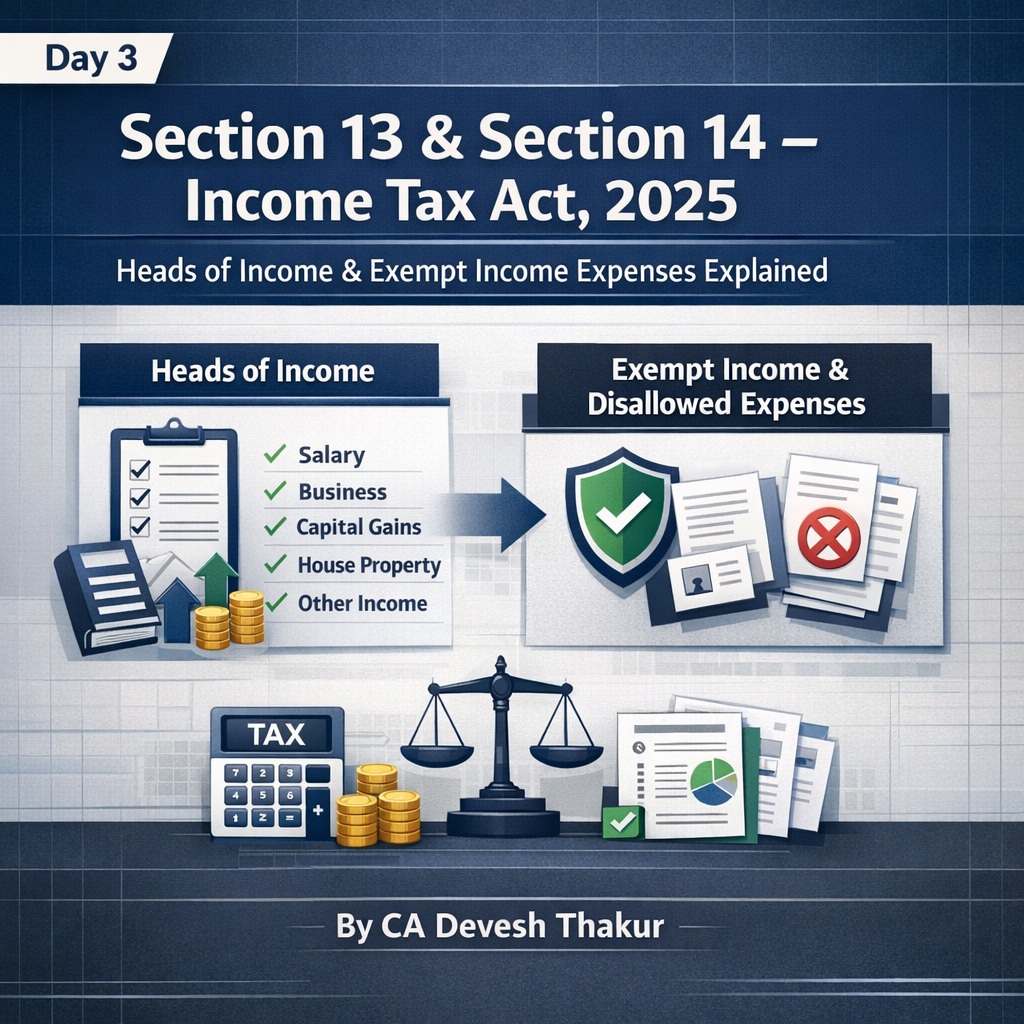
Day 3 of 15 Days Income Tax Act, 2025 Series
Section 13 – Heads of Income & Section 14 – Expenditure Relating to Exempt Income
Introduction
On Day 3 of the 15 Days Income Tax Act, 2025 Series, we focus on two foundational provisions that every tax student and professional must clearly understand:
- Section 13 – Heads of Income
- Section 14 – Income not forming part of total income and expenditure relating to such income (earlier Section 14A of the 1961 Act)
These sections form the base for classification of income and disallowance of expenses, and mistakes here directly impact tax computation, assessments, and exam scores.
Section 13 – Heads of Income (Income-tax Act, 2025)
Why Heads of Income Matter
Income tax law does not tax income randomly. Every income must first be classified under a specific head, because:
- Different heads have different computation rules
- Deductions vary from head to head
- Tax rates and set-off provisions depend on classification
Correct classification = correct tax liability.
Heads of Income under Section 13 (2025 Act)
The Income-tax Act, 2025 classifies income into five heads:
- Salaries
- Income from House Property
- Profits and Gains of Business or Profession
- Capital Gains
- Income from Other Sources
Important Historical Change – Interest on Securities
Under Section 14 of the Income-tax Act, 1961, there was earlier a separate head:
“B — Interest on Securities”
However, this head was omitted by Act 26 of 1988, Section 8, with effect from 1 April 1989.
Practical Meaning:
- Since 1‑4‑1989, Interest on Securities is no longer a separate head
- Such income is taxable under Income from Other Sources
- The Income-tax Act, 2025 continues this simplified structure
This is a frequently tested factual point in exams and interviews.
Section 14 – Income Not Forming Part of Total Income and Related Expenditure
Section 14 of the Income-tax Act, 2025 corresponds to Section 14A of the Income-tax Act, 1961.
The substance of the law remains the same, but the drafting has been simplified and structured to reduce litigation.
Core Principle of Section 14
If income is exempt from tax, any expenditure incurred to earn that income shall not be allowed as a deduction.
This principle ensures that tax-free income does not indirectly reduce taxable income.
Section 14(1) – Basic Rule
No deduction shall be allowed for any expenditure incurred by the assessee in relation to income which does not form part of total income under the Act.
Role of the Assessing Officer – Section 14(2)
The Assessing Officer (AO) can intervene when he is not satisfied with the assessee’s claim, specifically in two situations:
- The assessee has claimed an incorrect amount of expenditure, or
- The assessee claims that no expenditure was incurred in relation to exempt income
In such cases, the AO shall determine the amount of disallowable expenditure as per the prescribed method.
The AO cannot act arbitrarily; statutory methodology must be followed.
Section 14(3) – Important Clarification
A major clarification carried forward from earlier law:
Even if the exempt income:
- Has not accrued, or
- Has not arisen, or
- Has not been received during the year
the expenditure shall still be disallowed, provided such expenditure has been incurred in relation to exempt income.
This provision aims to prevent tax planning through timing differences and significantly reduces litigation.
Comparison: 1961 Act vs 2025 Act
| Particulars | 1961 Act (Section 14 & 14A) | 2025 Act (Section 13 & 14) |
| Heads of Income | 6 (earlier) | 5 |
| Interest on Securities | Separate head earlier | Merged into Other Sources |
| Drafting style | Complex, explanatory | Clear, clause-based |
| Expense disallowance | Section 14A | Section 14 |
| Litigation scope | High | Reduced intent |
Key Exam Takeaways
- Interest on Securities has not been a separate head since 1‑4‑1989
- Exempt income always triggers expense disallowance
- Even if exempt income is not received, related expenditure can be disallowed
- AO can recompute disallowance if not satisfied, but only through prescribed methods
One-Line Memory Rule
“Exempt income ho ya na ho, agar expense exempt income se related hai — disallow hoga.”
What’s Next in the Series?
This was Day 3 of the 15 Days Income Tax Act, 2025 Series. In the coming days, we will cover:
- Computation mechanisms
- Deductions and disallowances
- Practical illustrations and exam-focused insights
Prepared by CA Devesh Thakur as part of the 15 Days Income Tax Act, 2025 learning series.