Home Blog GST GST Simplified by CA Devesh Thakur – Day 14/30 days challenge

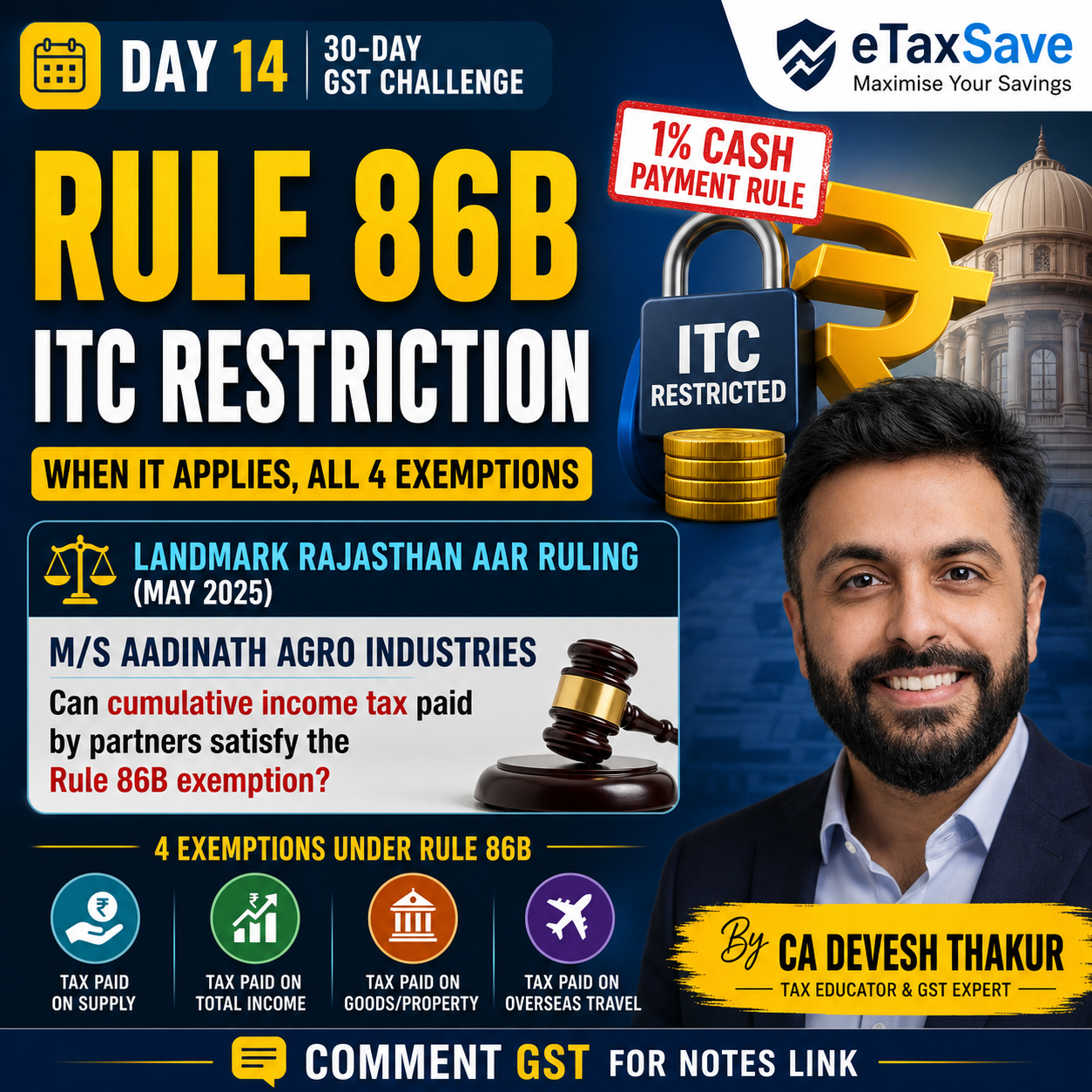
GST Simplified by CA Devesh Thakur – Day 14/30 days challenge

“Cross ₹50 lakh? Here’s why you may be forced to pay GST in cash—and how the AAR ruling changes the game for partnerships.”

0
Rule 86B, Rule 86B GST India, ITC restriction GST, GST 1% cash rule, input tax credit restriction, GST cash payment rule, GST turnover 50 lakh limit, GST compliance India, CGST rules 86B, GST exemption conditions, Rajasthan AAR ruling 2025, Aadinath Agro Industries case, GST for partnership firms, GST litigation updates, GST practical issues, ITC utilisation rules, GST law interpretation India, cadeveshthakur
Day 14 – Rule 86B ITC Restriction | AAR: Aadinath Agro Industries | CA Devesh Thakur | eTaxSave
🔥 30 Days GST Challenge — Day 14 of 30  |  View Full Challenge →
🏆 30 Days GST Challenge  ·  CA Devesh Thakur
Day 14
Rule 86B — ITC Use Restriction
When must you pay at least 1% GST in cash? All 4 exemptions explained with the landmark AAR ruling
⚖️ AAR: Rajasthan AAR vs M/s Aadinath Agro Industries  ·  May 2025
Rule 86B CGST Rules ITC Restriction ₹50 Lakh Turnover 1% Cash GST Advance Ruling Partnership Firm
📝

Handwritten Notes — Day 14

Three pages of handwritten notes covering Rule 86B — what triggers it, how the restriction works, and all 4 exemptions. Download with one click (watermarked with CA Devesh Thakur | eTaxSave.com).

📄 Note Page 1 — Rule 86B Overview & Case Facts

AAR overview, firm details, monthly turnover, income tax data & issues raised

Part A
💡 Comment “D14” on Instagram for full notes

📄 Note Page 2 — Rule 86B: The Restriction & How It Works

Notification No. 94/2020, effective date, ₹50 lakh trigger, 99% ITC limit, 1% cash mandate

Part B
💡 Comment “D14” on Instagram for full notes

📄 Note Page 3 — 4 Exemptions from Rule 86B

All 4 exemption categories: Income Tax, GST Refund, Cash GST already paid, Special Entities

Part C
💡 Comment “D14” on Instagram for full notes

🎬 Watch the Reel

Watch Day 14 — Rule 86B ITC Restriction

Watch the full Reel on Instagram  ·  Open on Instagram →  ·  Full challenge at eTaxSave.com/30-days-gst-challenge

📜

What is Rule 86B?

Rule 86B of the CGST Rules, 2017 is a restriction on the use of Input Tax Credit (ITC) from the electronic credit ledger. It was introduced vide Notification No. 94/2020 – Central Tax, dated 22nd December 2020, and became effective from 1st January 2021.

The primary objective of Rule 86B is to curb tax evasion, fraudulent ITC claims, and bogus invoicing under GST. Before its introduction, many businesses were fraudulently utilizing 100% of their ITC without paying any actual tax in cash.

📌 Rule 86B — Exact Legal Text (Key Extract)

“Notwithstanding anything contained in these rules, the registered person shall not use the amount available in electronic credit ledger to discharge his liability towards output tax in excess of ninety-nine per cent of such tax liability, in cases where the value of taxable supply other than exempt supply and zero-rated supply, in a month exceeds fifty lakh rupees.”


When Does Rule 86B Apply?

Rule 86B is triggered automatically when your monthly taxable turnover crosses a threshold. The calculation excludes exempt and export supplies.

Rule 86B Trigger
Monthly Taxable Sales
(Excluding Exempt Supplies + Export / Zero-Rated Supplies)
exceeds
₹50,00,000
per month
↓ Then ↓
Cannot use 100% ITC — Must pay minimum 1% GST in Cash (only 99% via ITC)

🔗 How the 99% / 1% Split Works

Total GST Liability
Max 99% via ITC
+
Min 1% in Cash
=
✅ Rule 86B Complied
Example: GST liability of ₹1,00,000 → Max ₹99,000 via ITC credit ledger + Min ₹1,000 must be paid in cash via electronic cash ledger.

4 Exemptions — Rule 86B Does NOT Apply If…

The proviso to Rule 86B provides 4 categories of exemptions. If any one of these conditions is satisfied, the registered person is fully exempted from the Rule 86B cash payment restriction and can use 100% ITC.

1
💼 Income Tax Paid > ₹1 Lakh
The proprietor, Karta, Managing Director, or any two partners / whole-time directors / members of managing committee / board of trustees have paid more than ₹1,00,000 as income tax under the Income Tax Act, 1961, in each of the last two financial years (for which the time limit to file ITR has expired).
Exemption (a)
2
📦 GST Refund > ₹1 Lakh (Export / Inverted Duty)
The registered person received a refund exceeding ₹1 lakh in the preceding financial year on account of unutilised ITC under:
• Export with payment of tax (zero-rated supply), OR
• Inverted tax structure (where input tax rate > output tax rate)
Exemption (b) & (c)
3
💵 Already Paid Cash GST > 1% This FY
The registered person has already discharged more than 1% of total output tax liability through the electronic cash ledger, applied cumulatively up to the current month in the current financial year. Once you cross this threshold, Rule 86B no longer applies.
Exemption (d)
4
🏛️ Special Entities
The registered person is any of the following:
Government Department
Public Sector Undertaking (PSU)
Local Authority
Statutory Body
Exemption (e)

⚠️ Key Point on Exemption 1 — Income Tax Threshold

  • The ₹1 lakh income tax must be paid individually by the specified person — not cumulatively
  • Applicable persons: Proprietor (for proprietorship), Karta (HUF), MD / WTD (company), Any Two Partners (partnership), Members of managing committee (AOP), Board of Trustees (trust)
  • This is the most commonly claimed exemption — and the one at the center of the AAR ruling below
  • The IT paid must be in each of the last two financial years (both years, not just one)

⚖️

Landmark AAR Ruling — Rajasthan AAR, May 2025

Now let’s see how Rule 86B played out in a real case — M/s Aadinath Agro Industries, a partnership firm from Rajasthan, sought an Advance Ruling on whether they qualified for the Rule 86B exemption under category (a).

⚖️ Advance Ruling

Rajasthan AAR vs M/s Aadinath Agro Industries

Ruling No.
RAJ/AAR/2025-26/06
Date of Ruling
23 May 2025
Applicant
M/s Aadinath Agro Industries
Business
Spice Processing & Trading (Partnership Firm)
GSTIN
08ABXFA7290E1ZX
CA Rep.
Mr. Mukesh Chordiya (C.A.)
Clause (Sec. 97(2))
(b) Applicability of notification
Personal Hearing
17 April 2025
📊

Firm’s Facts — Income Tax Data

The firm’s monthly taxable turnover exceeded ₹50 lakh, making Rule 86B applicable. The firm and its partners were utilizing 100% ITC. The firm applied for a ruling on whether their combined income tax payments qualified them for exemption.

Entity / PartnerFY 2022-23 (₹)FY 2023-24 (₹)Individually > ₹1L?
The Firm0.000.00❌ No
Partner 148,76632,274❌ No
Partner 290,07272,153❌ No
Partner 30.000.00❌ No
Total (Firm + All Partners)₹1,38,838₹1,04,427✅ Cumulatively > ₹1L

🔍 The Problem

No individual partner paid more than ₹1 lakh in income tax in either of the last two financial years. However, the firm and its partners together paid well above ₹1 lakh cumulatively. The applicant argued that this cumulative amount should qualify for the Rule 86B exemption.

Two Issues Raised Before AAR

Cumulative IT — Valid for Exemption?
Can the total income tax paid by the firm and its partners together be considered for the exemption under Rule 86B(a)?
No Single Partner > ₹1L — Still Exempt?
If no single partner has paid more than ₹1 lakh in income tax, but the firm and partners together have — does the exemption still apply?
🗣️

Applicant’s Arguments — Why They Claimed Exemption

The CA (Mr. Mukesh Chordiya) advanced the following arguments on behalf of the firm:

1
Financial Interdependence: A partnership firm and its partners are financially interlinked. The firm’s income ultimately flows to partners via profit share, remuneration, and interest. So IT paid by partners is effectively IT on firm income.
2
Ambiguity in the Rule: Rule 86B uses the phrase “any of its two partners have paid more than ₹1 lakh.” The rule does not explicitly state whether the ₹1 lakh threshold applies to each partner separately or cumulatively. Under the principle of CIT v. Vegetable Products Ltd. (1973), ambiguities should be resolved in the taxpayer’s favour.
3
Legislative Intent: Rule 86B was enacted to target fraudsters, not compliant businesses. CBIC itself stated that the rule would apply to less than 0.5% of the total 1.2 crore taxpayer base. Penalizing a genuine tax-paying firm contradicts this intent.
4
Structural Hardship: The 1% mandatory cash payment creates working capital strain, increases borrowing costs, and adversely impacts MSMEs — contrary to the Government’s stated policy of ease of doing business.
🔬

AAR’s Reasoning — How They Decided

The Rajasthan AAR (Advance Ruling No. RAJ/AAR/2025-26/06, dated 23.05.2025) carefully examined the provisions of Rule 86B and ruled as follows:

1
Rule 86B is clearly applicable: The firm’s own admission that monthly turnover exceeds ₹50 lakh triggers Rule 86B without question.
2
The exemption language is unambiguous: Rule 86B(a) states that the restriction shall not apply if “any of its two partners… have paid more than one lakh rupees as income tax… in each of the last two financial years.” This is an individual threshold — each partner must individually cross ₹1 lakh in each of both years.
3
No provision for cumulative consideration: The AAR found that “there is no provision of exemption for such conditions in the said rule where exemption can be considered for total income tax paid by the partners and the firm together.” The law is clear — no cumulative computation is permitted.
4
Individual analysis of partners failed: In FY 2022-23 and FY 2023-24, neither the individual partner nor the firm paid income tax more than ₹1 lakh in any financial year. Hence, Exemption (a) is not available.
📋

The Ruling — Final Answer

⚖️ Official Ruling — RAJ/AAR/2025-26/06 dated 23.05.2025
Question 1: Can the total income tax paid by the firm and its partners be considered for the exemption under Rule 86B?
ANS 1 — NO ❌
Question 2: If no single partner has paid more than ₹1 lakh in tax, but the firm and partners together have — does the exemption still apply?
ANS 2 — NO ❌

Signed by: Utkarsha (Member, Central Tax) & Dr. Akhedan Charan (Member, State Tax) | Dated: 23/05/2025

📄 Download the Full AAR Order
Rajasthan AAR · Ruling No. RAJ/AAR/2025-26/06 · 11 Pages · Official GST Order
Download AAR Ruling PDF
📑 11 Pages · 🏛️ Rajasthan AAR · 📅 May 2025 · 📌 Rule 86B CGST Rules

💡

Key Takeaways — What You Must Remember

✅ 5 Critical Points from Day 14

  • Rule 86B applies when monthly taxable supplies (excluding exempt + zero-rated) exceed ₹50 lakh in a month — effective from 1st January 2021
  • The restriction: Cannot use more than 99% of GST liability via ITC — must pay a minimum of 1% in cash via the electronic cash ledger
  • Exemption (a) — Income Tax: The ₹1 lakh income tax threshold applies individually to each specified person (any two partners / MD / proprietor etc.) — cumulative computation of the firm + partners is NOT permitted
  • AAR ruling (May 2025): Rajasthan AAR ruled against M/s Aadinath Agro Industries — confirmed that cumulative income tax of firm and partners cannot be clubbed for Rule 86B exemption. Each partner must individually exceed ₹1 lakh in each of both preceding financial years
  • Practical tip: If you are a partnership firm with turnover exceeding ₹50 lakh/month, check that at least any two partners have individually paid > ₹1 lakh IT in each of the last 2 years — or plan to pay 1% GST in cash every month

🧠 Quick Memory Map — Rule 86B

  • When: Monthly taxable T/O > ₹50 Lakh (excl. exempt + export)
  • Restriction: Max 99% via ITC → Min 1% cash compulsory
  • Introduced: Notification No. 94/2020-CT, w.e.f. 01.01.2021
  • Exemption 1 (IT): Any 2 partners / MD / Proprietor individually paid > ₹1L IT in each of last 2 FYs
  • Exemption 2 (Refund): GST refund > ₹1L last year (export / inverted duty)
  • Exemption 3 (Cash paid): Already paid > 1% of GST in cash this FY cumulatively
  • Exemption 4 (Entity): Govt Dept / PSU / Local Authority / Statutory Body
  • AAR (May 2025): Cumulative IT of firm + partners — NOT eligible for exemption
🔜

Coming Up — Day 15 of #30DaysGSTChallenge

Stay tuned for Day 15! Comment “D14” on Instagram for full Day 14 notes. Follow @cadeveshthakur.official on Instagram & Threads. Full challenge at eTaxSave.com →

NO COMMENTS

LEAVE A REPLY

Please enter your comment!
Please enter your name here

Exit mobile version