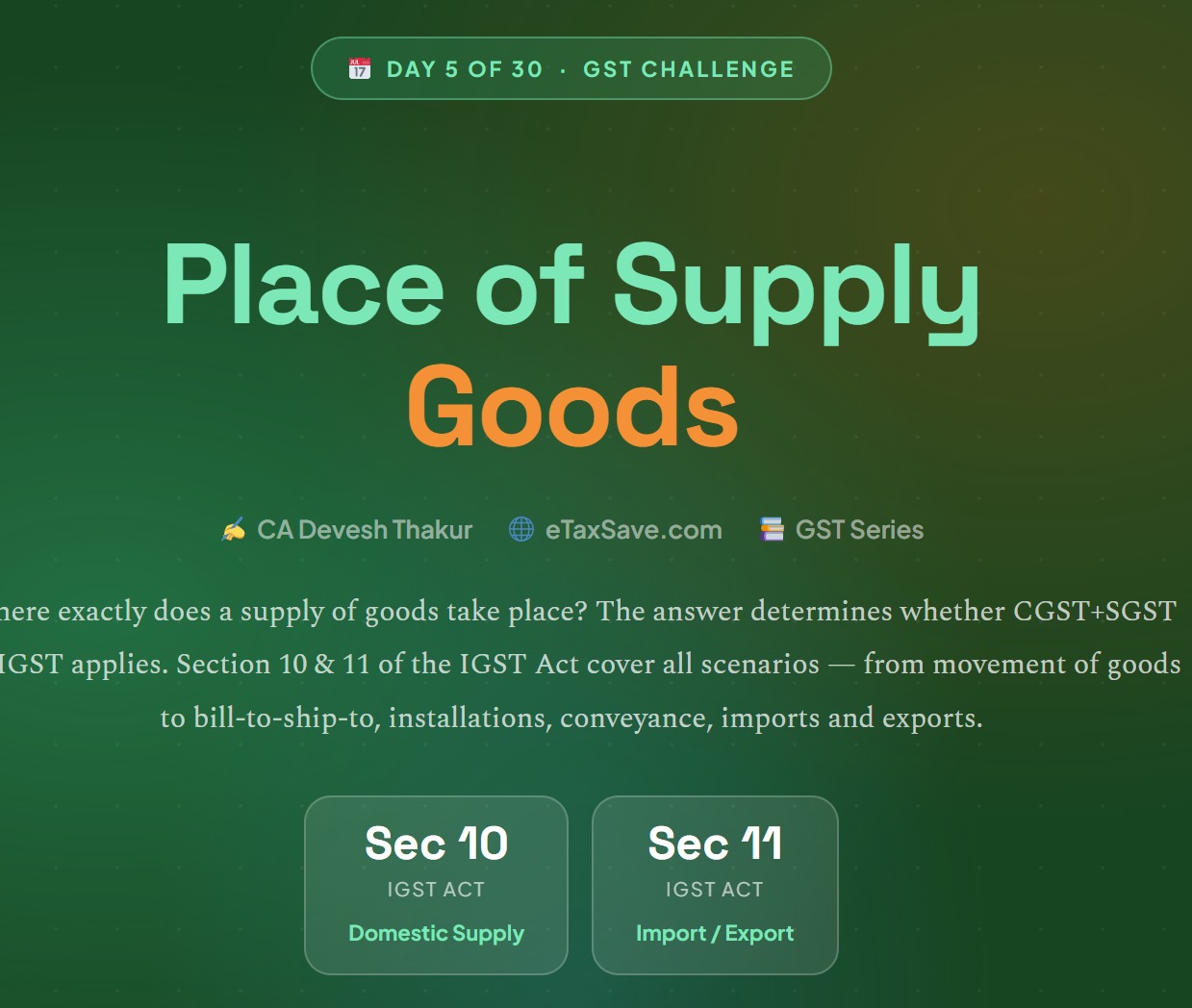
Place of Supply
Goods
Where exactly does a supply of goods take place? The answer determines whether CGST+SGST or IGST applies. Section 10 & 11 of the IGST Act cover all scenarios — from movement of goods to bill-to-ship-to, installations, conveyance, imports and exports.


📌 Comment ‘DAY5’ on Instagram to get full notes.
Watch Day 5 GST Reel — CA Devesh Thakur
📲 Follow @cadeveshthakur.official for daily GST challenge updates!
What is Place of Supply?
Place of Supply (POS) is one of the most critical concepts in GST — it determines the state where the supply is deemed to occur, which in turn decides whether CGST + SGST (intra-state) or IGST (inter-state) is applicable, and which state government receives the tax revenue.
For goods, two sections of the IGST Act govern this — Section 10 for domestic supplies and Section 11 for imports and exports.
Supply with Movement
Bill to Ship to
No Movement
Assembly / Install
On Conveyance
Import / Export
Section 11 — Import & Export of Goods
Section 11 of the IGST Act deals with the place of supply when goods cross India’s borders — either coming in (import) or going out (export). These are straightforward rules with clear, fixed answers.
Goods Imported into India
When goods are brought into India from a foreign country, the place of supply is the location of the importer — i.e., the state where the importer is registered or located.
Goods Exported from India
When goods are sent out of India to a foreign country, the place of supply is a location outside India — i.e., the destination country. Exports are zero-rated under GST.
Section 10 — Domestic Supply of Goods
Section 10 of the IGST Act covers all domestic (within India) supply scenarios for goods. It has five distinct rules — applied in a specific order depending on the nature of the transaction. Let’s go through each one exactly as covered in the note.
Supply Involves Movement of Goods
Sec 10(1)(a) — Most Common RuleWhen goods are physically moved from one place to another, the Place of Supply is the location where movement of goods terminates — i.e., where the goods are finally delivered to the recipient. This is the most frequently applied rule.
POS = Agra (UP) — where movement terminates → IGST applies (Delhi → UP)
Bill to Ship to — Third Person Involved
Sec 10(1)(b) — Deeming FictionWhen goods are delivered by the supplier to a recipient or another person on the direction of a third person, a special deeming fiction applies. The law “deems” that the third person has received the goods — “Maan liya jaega ki 3rd person ne goods receive kiya”. Therefore POS is the location of the third person (the one who directed the supply).
POS = Kerala — location of the 3rd person (Deeming Fiction: goods deemed received in Kerala)
⚠️ Why Deeming Fiction?
In a Bill-to-Ship-to transaction there are actually two supplies: (1) Supplier → 3rd Person (Kerala), and (2) 3rd Person → Recipient (Delhi). The law uses this fiction to tax the first leg at the 3rd person’s location, ensuring the correct state gets the GST revenue.
No Movement of Goods
Sec 10(1)(c) — Goods Don’t MoveWhen the supply does not involve any physical movement of goods — for example, goods sold at a shop where the buyer picks them up directly — the Place of Supply is the location of goods at the time of delivery.
POS = Delhi (Location of the Retail Store) — where goods are at time of delivery
Goods Assembled or Installed
Sec 10(1)(d) — Installation RuleWhen goods are supplied and also need to be assembled or installed at a specific location (e.g., machinery, equipment, AC units), the Place of Supply is the place of installation or assembly — regardless of where the supplier is located.
POS = Gujarat — place of installation/assembly → IGST applies (Kerala → Gujarat)
Goods Supplied on Board a Conveyance
Sec 10(1)(e) — Train / Bus / Ship / AircraftWhen goods are supplied on board a conveyance — such as food/snacks sold on a train, ship, aircraft, or bus — the Place of Supply is the location where the goods are taken on board (the boarding point / origin station), not where they are consumed.
POS = Delhi — location where goods were taken on board the conveyance
Quick Reference Summary — All 5 + 2 Rules
| # | Scenario | Section | Place of Supply | Example |
|---|---|---|---|---|
| 1 | Movement of Goods | 10(1)(a) | Where movement terminates | Delhi → Agra: POS = Agra |
| 2 | Bill to Ship to (3rd Person) | 10(1)(b) | Location of 3rd Person | 3rd person in Kerala: POS = Kerala |
| 3 | No Movement of Goods | 10(1)(c) | Location at time of delivery | Retail store Delhi: POS = Delhi |
| 4 | Assembly / Installation | 10(1)(d) | Place of installation/assembly | Installed in Gujarat: POS = Gujarat |
| 5 | On Board Conveyance | 10(1)(e) | Where goods taken on board | Boarded at Delhi: POS = Delhi |
| 6 | Import into India | Sec 11 | Location of the Importer | Importer in Mumbai: POS = Mumbai |
| 7 | Export from India | Sec 11 | Location outside India | Exported to USA: POS = USA |
🧠 Why Place of Supply Matters — The Big Picture
- If POS is in the same state as the supplier → CGST + SGST applies (intra-state).
- If POS is in a different state from the supplier → IGST applies (inter-state).
- Getting POS wrong = wrong tax charged = compliance risk and potential penalties.
- The state where POS falls is the state that earns the GST revenue — hence the strict rules.


