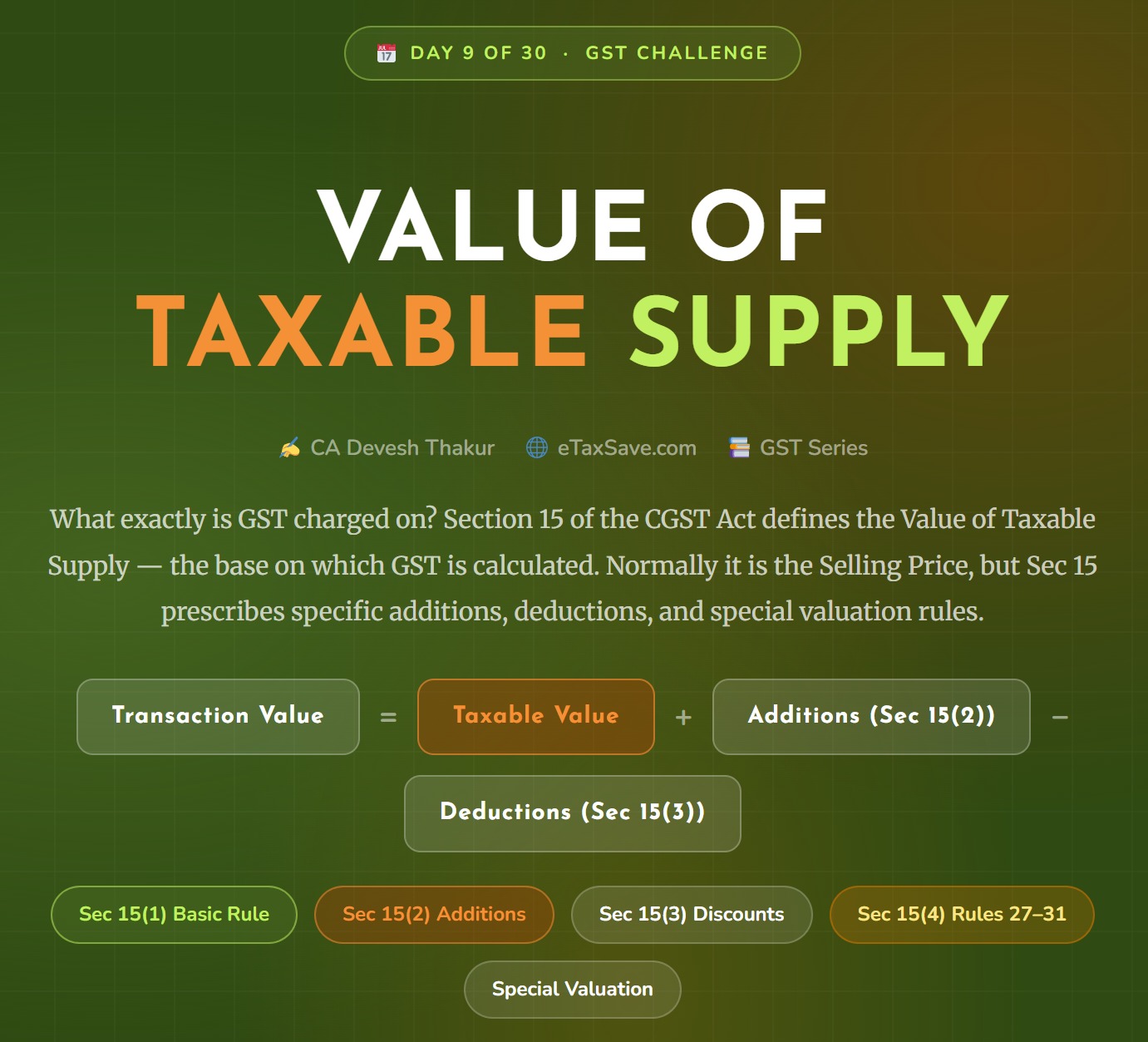
Value of
Taxable Supply
What exactly is GST charged on? Section 15 of the CGST Act defines the Value of Taxable Supply — the base on which GST is calculated. Normally it is the Selling Price, but Sec 15 prescribes specific additions, deductions, and special valuation rules.


📌 Comment ‘YES’ on Instagram to know more + Bonus Video!
Watch Day 9 GST Reel — CA Devesh Thakur
📲 Follow @cadeveshthakur.official for daily GST challenge updates!
What is Value of Taxable Supply?
GST is a percentage-based tax — but a percentage of what exactly? The answer is the Value of Taxable Supply — the amount on which GST is charged. Section 15 of the CGST Act, 2017 defines this comprehensively.
Think of it this way — TV = Taxable Value, S = Seller, B = Buyer. The transaction value between them is the starting point, but Section 15 tells us what to add and what to deduct to arrive at the final taxable value.
Sec 15(1) — Basic Rule
Transaction Value = Taxable Value
The Transaction Value — the price actually paid or payable for the supply — is accepted as the Taxable Value, provided BOTH the following conditions are satisfied:
☁️ “Does Not Claim It Back” — Cloud Note
If Buyer (B) pays something on behalf of Seller (S) and does NOT claim it back from the seller, it forms part of the consideration and must be added to taxable value. This links directly to Sec 15(2) additions.
Sec 15(2) — What to “Add” to Value
Five Mandatory Inclusions in Taxable Value
Other Taxes (Not GST)
Any other taxes, duties, cesses, fees charged separately — e.g., Custom Duty on imports — must be added to taxable value.
Expenses Borne by Buyer on Seller’s Behalf
If Buyer (B) pays freight/expense that Seller (S) was liable to pay — and does not claim it back — it gets added. e.g., B paid freight that S was liable for.
Incidental Charges
Charges incidental to the supply such as Commission and Packing charges are included in taxable value.
Interest / Late Fees / Penalty
Any interest, late fees or penalty charged by Seller for Buyer’s delayed payment (e.g., ₹500 extra paid as late charges) is added to taxable value.
Subsidies Linked to Price (Except Govt. Subsidy)
Subsidies given by private parties or NGOs that are linked to the price must be added. Government subsidies are excluded from this rule.
📌 Key Rule for Additions
All five items above form part of the taxable value whether or not they are charged separately in the invoice. The tax base cannot be reduced by billing these items separately.
Sec 15(3) — What to “Exclude” — Discounts
Discounts — When Allowed as Deduction
Discounts may or may not be deductible from taxable value depending on the timing:
Pre-Supply Discount
- Discount given before or at the time of supply
- Mentioned on the invoice
- e.g., Trade discount, cash discount shown on invoice
Post-Supply Discount
- Must be as per agreement made before supply
- Must be linked to the specific invoice
- Buyer must reverse the proportionate ITC (Input Tax Credit) claimed
⚠️ Critical — ITC Reversal for Post-Supply Discount
When a post-supply discount is given, the buyer would have already claimed ITC on the full original value. The discount effectively reduces the taxable value — so the buyer must reverse the ITC proportionate to the discount. Without this reversal, the discount deduction is NOT allowed to the seller.
Sec 15(4) — Transaction Value Not Available
When Transaction Value Cannot Be Determined
Sometimes the transaction value is not available or not acceptable (e.g., related party transactions, barter deals, no consideration). In such cases, Sec 15(4) directs us to use the GST Valuation Rules (Rules 27 to 31):
Special Valuation — Notified Supplies
For certain notified categories of supply, the Government has prescribed Special Valuation Rules that override Sec 15(1) to 15(4). These rules exist because the standard transaction value approach does not work well for certain high-risk or unique supply types.
🔑 These Rules Override Sec 15(1) to 15(4)
When a supply falls under any of these special categories, the standard Sec 15 rules do not apply. Instead, the specific rule prescribed for that category governs the valuation.
Lottery & Betting
Special valuation for lottery tickets and betting transactions
Online Gaming
Valuation for online gaming platforms and virtual digital assets
Actionable Claims
Casinos and other actionable claim transactions have separate valuation
📌 Comment “YES” to Know More + Bonus Video
As noted on the handwritten note — comment “YES” on the Instagram post to get detailed notes and access the Bonus Video covering special valuation rules in depth. Follow @cadeveshthakur.official on Instagram!
Section 15 — Complete Summary
🧠 The Big Picture — Value of Taxable Supply
- Sec 15(1) — Basic Rule: Transaction Value = Taxable Value, IF S & B not related AND price is sole consideration
- Sec 15(2) — Add: Other taxes (not GST), Buyer’s expenses on Seller’s behalf, Incidental charges, Interest/Late fees/Penalty, Private subsidies linked to price
- Sec 15(3) — Exclude: Pre-supply discounts (always); Post-supply discounts only if: pre-agreed, linked to invoice, buyer reverses ITC
- Sec 15(4) — Fallback: When transaction value is unavailable — use Rules 27–31 (Open Market Value, Cost + % etc.)
- Special Valuation: Rule 31A (Lottery/Betting), 31B (Online Gaming), 31C (Casinos) — these OVERRIDE Sec 15(1)–(4)