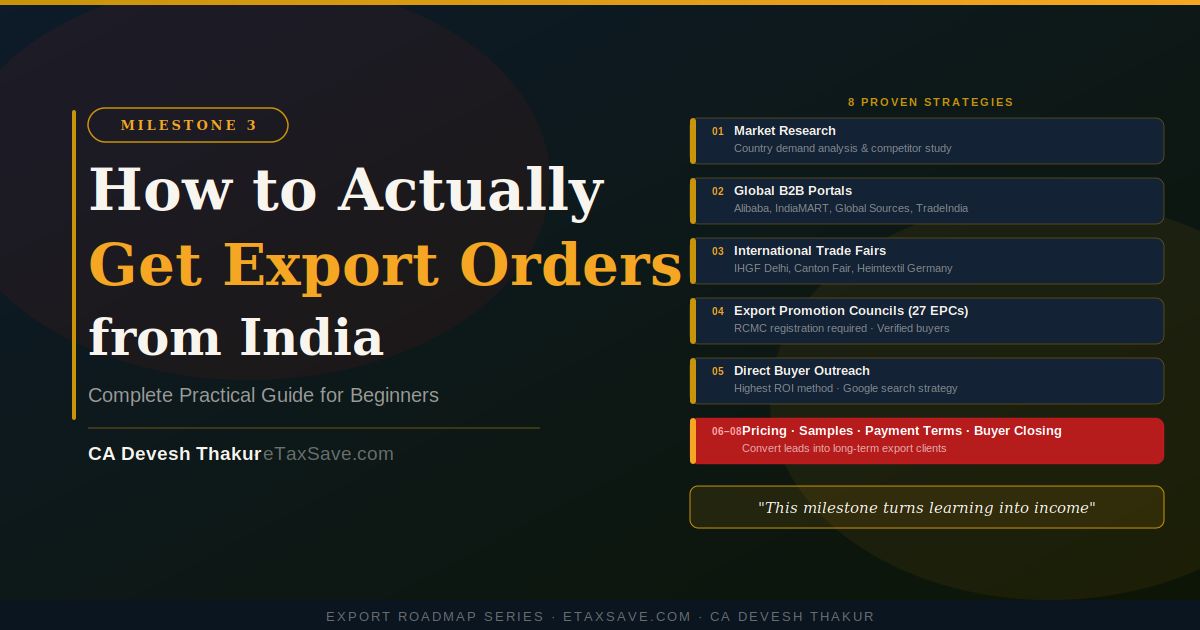
🌍 Milestone 3 of the Export Roadmap: How to Actually Get Export Orders from India
(By CA Devesh Thakur – EtaxSave Export Education Initiative)
Starting an export business is a powerful dream for many Indian entrepreneurs. India today is one of the fastest-growing export-driven economies in the world. However, true success in exports does not begin with IEC registration, company formation, or documentation alone—it begins when you secure your first real international export order.
As part of my 6-Milestone Export Roadmap Initiative, Milestone 3 is the most crucial stage because this is where a learner turns into a real exporter. In this detailed guide, I will take you through practical, ground-level strategies that actually work in the real market.
This guide is specifically prepared for:
- First-time exporters
- MSME owners
- Manufacturers
- Traders
- E-commerce sellers
- Merchant exporters
- Students of international trade
✅ Why Milestone 3 Is the Backbone of Export Success
Many exporters fail not because they lack knowledge of registration or documentation—but because they do not know how to systematically attract and close international buyers. This milestone trains you to:
- Identify the right global markets
- Find genuine buyers
- Pitch professionally
- Price products correctly
- Choose the correct HS Code
- Send samples effectively
- Secure safe payment terms
Without these skills, export remains only a theoretical concept.
🌍 1. Market Research: Choosing the Right International Market
Before searching for buyers, it is essential to understand where your product can actually sell. Export success depends heavily on demand analysis and country selection.
Key Factors to Study:
- Import volume of your product
- Market competition
- Quality standards required
- Import regulations
- Packaging norms
- Payment patterns
- Logistics feasibility
Reliable Market Research Tools:
- DGCIS Export-Import Data
- Export Promotion Councils (EPCs)
- Indian Embassies & Foreign Trade Missions
- FTA & PTA Advantage Lists
✅ Example:
If you manufacture ceramic products, major importing nations include the USA, Germany, UAE, UK, and France.
This data-based approach protects you from blind exporting.
🔎 2. How to Find Genuine International Buyers
This is the most common question every exporter asks:
“Where do I get real buyers from?”
Below are the most effective practical methods used by successful exporters:
✅ Method 1: International B2B Portals
These platforms digitally connect exporters with importers worldwide:
- Alibaba
- IndiaMART International
- TradeIndia
- Global Sources
- ExportersIndia
To succeed here:
- Upload professional product images
- Mention MOQ clearly
- Show certifications
- Define payment & shipping terms
- Respond to inquiries within 24 hours
A weak profile never converts into orders.
✅ Method 2: International Trade Fairs & Exhibitions
Physical interaction builds maximum trust in export trade. Leading exhibitions include:
- IHGF Delhi Fair (India)
- Canton Fair (China)
- Heimtextil (Germany)
- Dubai Global Trade Expo
These events provide:
- Direct buyer negotiation
- Bulk order potential
- Brand visibility
- International market exposure
✅ Method 3: Buyer-Seller Meets via Export Promotion Councils (EPCs)
India has 27 EPCs, each dedicated to one sector. These councils arrange:
- Global buyer meetings
- Virtual export expos
- MSME export promotion schemes
Some examples:
- EPCH – Handicrafts
- AEPC – Apparel
- Spices Board – Spices
- APEDA – Agri exports
To participate, you must obtain RCMC (Registration Cum Membership Certificate).
✅ Method 4: Direct Buyer Outreach (Highest ROI Method)
This is the most underused but most profitable method.
Use Google search with these patterns:
- “Wholesale importers of leather wallets in USA”
- “Bulk handicraft buyers in Europe”
- “Ceramic home décor distributors in Dubai”
Collect:
- Company name
- Email address
- Website
- Import history (if available)
Then approach with:
- Introduction mail
- Product catalogue
- Certificatons
- Company profile
- Export pricing
This strategy builds long-term clients.
📧 3. Buyer Communication & Professional Outreach Script
✅ Short WhatsApp / Instagram DM Script:
Hello, we are Indian exporters of [product]. We supply globally with competitive pricing and international standards. May I share our catalogue with you?
✅ Professional Buyer Email Script:
Subject: Reliable Export Supplier from India – [Product Name]
Dear [Buyer Name],
We are registered exporters from India (IEC & RCMC holder) engaged in the export of [product]. We supply to multiple international markets under FOB, CIF, and DDP terms with competitive pricing, strong packaging, and assured quality compliance.
We would be honored to share our catalogue and samples for your evaluation.
Warm Regards,
CA Devesh Thakur
💰 4. Export Pricing: The Most Critical Profit Formula
Incorrect pricing destroys export businesses faster than competition.
✅ Step 1: Base Manufacturing Cost
- Raw material
- Labour
- Power
- Factory overheads
✅ Step 2: Export-Specific Costs
- Packaging & labeling
- Inland transport
- CHA charges
- Freight (Air or Sea)
- Marine insurance (if CIF)
- Banking charges
- ECGC premium
✅ Step 3: Incoterm Selection
- EXW – Ex Works
- FOB – Free on Board
- CIF – Cost Insurance Freight
- DAP – Delivered at Place
- DDP – Delivered Duty Paid
Your liability and profit change with each Incoterm.
✅ Step 4: Profit Margin
Usually 10%–30% depending on:
- Product category
- Risk involved
- Competition
- Market entry stage
Your final export price must protect cost + currency risk + profit.
📦 5. HS Code (ITC-HS Code): The Identity of Your Product
Every export product is identified using an 8-digit ITC-HS Code.
Why HS Code Is Critical:
- Determines export eligibility
- Decides customs duty
- Governs GST refund
- Enables export incentives
- Controls product restrictions
Structure:
- First 2 digits = Chapter
- First 4 digits = Heading
- First 6 digits = Subheading
- Full 8 digits = Tariff line
Wrong HS code can result in:
- Customs penalties
- Shipment delay
- Export incentive loss
Always verify HS Code from the DGFT & ICEGATE portals.
📤 6. Sending Export Samples Professionally
Your sample represents your entire business credibility.
Follow these best practices:
- Export-grade packaging
- Moisture-proof sealing
- Branded labeling
- Accurate courier documents
- Tracking details shared instantly
A strong sample converts into a long-term export client.
🏦 7. Payment Terms & Risk Protection
Safest Payment Options for New Exporters:
- Advance 20%–30% + balance before shipment
- Letter of Credit (LC) for large orders
- PayPal / Stripe for e-commerce
Avoid:
- Full credit sales with unknown buyers
- Verbal promises without written agreement
- Shipping before payment confirmation
Also secure your payments using ECGC Export Credit Insurance.
🧠 8. Psychological Buyer Closing Techniques
Successful exporters use smart psychology:
✅ MOQ Anchoring
✅ Limited-time pricing
✅ Incoterm flexibility
✅ Faster response time
✅ Professional documentation
These techniques increase buyer trust rapidly.
✅ What You Achieve in Milestone 3
By completing this milestone, you gain:
- The skill to attract international buyers
- The ability to communicate professionally
- Knowledge to price products profitably
- Confidence to negotiate global orders
- Control over documentation & payments
This is the milestone that turns learning into income.
📊 Important Export Terms Used in Milestone 3
| Short Form | Full Form |
| IEC | Importer Exporter Code |
| HS Code | Harmonized System Code |
| ITC-HS | Indian Trade Classification – Harmonized System |
| EPC | Export Promotion Council |
| RCMC | Registration Cum Membership Certificate |
| FOB | Free on Board |
| CIF | Cost, Insurance & Freight |
| DDP | Delivered Duty Paid |
| DAP | Delivered at Place |
| MOQ | Minimum Order Quantity |
| LC | Letter of Credit |
| CHA | Customs House Agent |
| ECGC | Export Credit Guarantee Corporation |
| DGCIS | Directorate General of Commercial Intelligence & Statistics |
🇮🇳 Closing Message by CA Devesh Thakur – EtaxSave
Through this Export Roadmap Initiative, my mission is to ensure that Indian entrepreneurs do not fear global trade, but instead confidently enter international markets with proper legal, financial, and strategic knowledge.
Exports are not just business—they are nation-building tools. When an Indian exporter succeeds globally, India grows economically.
EXPORT ROADMAP (MILESTONE 5)
EXPORT ROADMAP (MILESTONE 6)