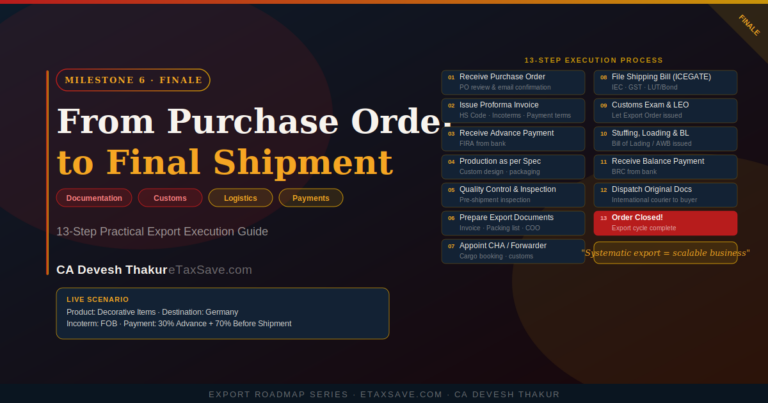
From Purchase Order to
Final Shipment Delivery
A step-by-step practical export execution guide — Documentation, Customs, Logistics & Payments.
🎯 Live Export Scenario We’ll Follow
Export Execution: 13-Step Process Flow
13 Steps — Complete Export Execution
The export process formally begins when the buyer issues a Purchase Order (PO). Once received, the exporter must review and confirm the PO via email to ensure mutual clarity on terms.
- Product specifications
- Quantity
- Price and currency
- Incoterms (FOB, CIF, etc.)
- Delivery schedule
- Packaging requirements
- Inspection or compliance conditions
The Proforma Invoice is the exporter’s official commercial offer based on the PO. It also serves as the basis for requesting advance payment.
- HS Code
- Unit price and total value
- Payment terms
- Incoterms
- Delivery timeline
- Validity period
After the buyer accepts the PI, the agreed advance (usually 20–30%) is received. The bank issues a Foreign Inward Remittance Advice (FIRA), important for compliance and remittance tracking.
- Bank remittance (TT / SWIFT)
- Export current account
- Online payment platforms (e-commerce exports)
Once advance payment is received, production begins strictly as per buyer requirements. Consistency with specifications is critical to avoid disputes and rejections.
- Custom design or colour
- Private branding or labelling
- Export-grade packaging
- Fragile or moisture-resistant packing
Before dispatch, goods must undergo quality verification. Quality compliance at this stage ensures smoother customs clearance and buyer confidence.
- Pre-shipment inspection
- Packaging strength tests
- Dimension and weight checks
- Third-party inspection certificates
Accurate documentation is the backbone of export execution. Incorrect or incomplete documentation can delay shipment and payment.
- Commercial Invoice & Packing List
- Certificate of Origin (if required)
- Insurance document (for CIF shipments)
- MSDS (for chemicals)
- Phytosanitary Certificate (agricultural goods)
A Customs House Agent (CHA) or Freight Forwarder is engaged to manage operational execution. The exporter provides all commercial and regulatory documents to the CHA.
- Booking cargo space
- Arranging pickup from factory
- Handling customs procedures
- Container stuffing and sealing
- Coordination with shipping lines
The CHA files the Shipping Bill electronically on the ICEGATE portal. A Shipping Bill Number is generated, which is central to export customs clearance.
- Invoice and Packing List
- IEC and GST details
- LUT / Bond (if applicable)
Customs authorities may examine goods and verify HS Code and declarations. If all conditions are met, customs issues the Let Export Order (LEO) — the formal approval allowing goods to be exported.
- Examine the goods
- Verify HS Code and declarations
- Check labels and markings
- Draw samples (if required)
After LEO, goods are loaded onto the vessel or aircraft. The carrier issues the Bill of Lading (BL) or Airway Bill (AWB), which acts as proof of shipment.
- Goods stuffed into container
- Container transported to port
- Cargo loaded onto vessel / aircraft
- BL or AWB issued by carrier
Once shipment is completed, the exporter sends scanned copies of documents to the buyer. Based on these, the buyer releases the balance payment. The bank then issues a Bank Realisation Certificate (BRC).
- Invoice
- Packing List
- Bill of Lading
- Certificate of Origin
- Insurance document (if applicable)
Original documents are couriered to the buyer through international courier services. These documents are required by the buyer for customs clearance at the destination.
- Import customs clearance at destination
- Payment of import duties
- Release of cargo at destination port
Once the buyer receives the goods and payment is realised, the export order cycle is successfully completed. This marks the final execution stage of an export transaction.
Key Export Terms Glossary
| Short Form | Full Form |
|---|---|
| PO | Purchase Order |
| PI | Proforma Invoice |
| HS Code | Harmonized System Code |
| TT | Telegraphic Transfer |
| FIRA | Foreign Inward Remittance Advice |
| CHA | Customs House Agent |
| ICEGATE | Indian Customs Electronic Gateway |
| LUT | Letter of Undertaking |
| LEO | Let Export Order |
| BL | Bill of Lading |
| AWB | Airway Bill |
| BRC | Bank Realisation Certificate |
| COO | Certificate of Origin |
Executing an export order is not complicated — but it must be systematic. When documentation, customs, logistics, and payments are aligned, exporting becomes a predictable and scalable business process.
This milestone completes the Export Execution Framework, helping exporters move from theory to real-world implementation.