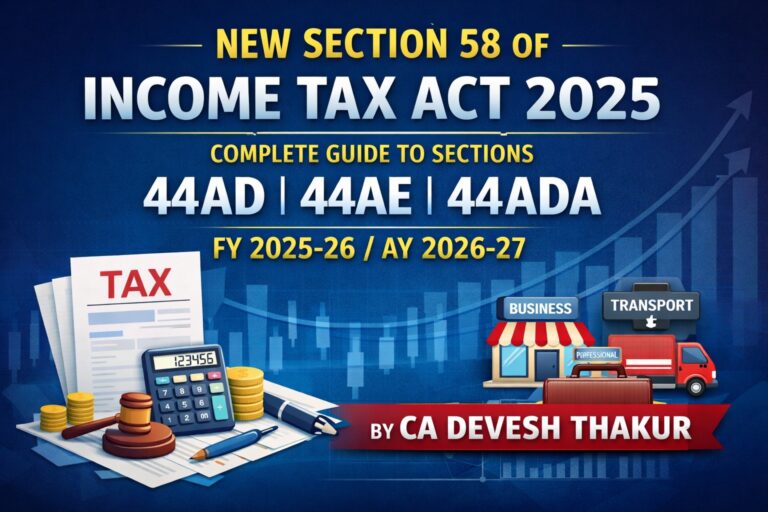
New Section 58 & Presumptive Taxation
Complete Guide
Sections 44AD · 44AE · 44ADA explained with practical examples, comparison tables and strategic guidance for FY 2025-26 / AY 2026-27.
Subscribe to @cadeveshthakur for weekly Income Tax & GST updates
Download Presumptive Taxation Student Notes
Section 58 · 44AD · 44AE · 44ADA · Printable Format · 100% Free
Follow first to unlock the download button
Introduction — Why Section 58 Matters
The Income Tax Act 2025 restructures and consolidates key provisions to prevent misuse of simplified tax schemes.
Section 58 historically dealt with certain disallowances under business income. Under the restructured Income Tax Act 2025, it clarifies and consolidates the non-allowability of certain deductions when income is computed under special provisions like presumptive taxation.
The objective is clear and non-negotiable:
- Prevent double deductions
- Avoid artificial reduction of presumptive income
- Ensure consistency in computation under special tax regimes
Structural Breakdown of Section 58
Section 58 covers five broad categories of non-deductible items.
| Component | What It Covers | Practical Meaning |
|---|---|---|
| Personal Expenses | Non-business use expenses | Cannot reduce taxable income |
| Capital Expenditure | Asset purchases | Not deductible as revenue expense |
| Income-Tax Payments | Tax paid to government | Not allowed as a deduction |
| Prohibited Payments | Payments that are illegal | Fully disallowed |
| Overlapping Deductions | Double benefit restriction | Prevents misuse of multiple provisions |
Section 44AD — Presumptive Taxation for Small Businesses
- Resident Individual
- Resident HUF
- Resident Partnership Firm (not LLP)
- Turnover within prescribed threshold
- LLP (Limited Liability Partnership)
- Company (Pvt Ltd / Public Ltd)
- Non-Resident assessee
- Professionals (covered under 44ADA)
| Mode of Receipt | Presumptive Income |
|---|---|
| Digital / Banking Receipts | 6% of Turnover |
| Cash Receipts | 8% of Turnover |
Section 44AE — Goods Transport Business
Section 44AE applies to persons engaged in plying, hiring or leasing goods carriages — and unlike 44AD, income is computed per vehicle, not as a percentage of turnover.
- Applies up to specified number of goods vehicles
- Income fixed per vehicle per month
- Separate rates for heavy and other vehicles
- No turnover threshold restriction
| Vehicle Type | Basis |
|---|---|
| Heavy Goods Vehicle | Per ton per month |
| Other Goods Vehicle | Fixed amount per month |
Section 44ADA — Presumptive Taxation for Professionals
- Chartered Accountants
- Doctors & Medical Professionals
- Lawyers & Legal Advisors
- Engineers
- Architects
- Interior Decorators
- Technical Consultants
- Other notified professions
- No detailed books of accounts required
- No audit (if conditions satisfied)
- Simplified ITR filing
- Lower compliance burden
Comparative Analysis — 44AD vs 44AE vs 44ADA
Choosing the wrong section is a compliance disaster. Here is the definitive comparison.
| Particulars | Section 44AD | Section 44AE | Section 44ADA |
|---|---|---|---|
| Applicable To | Small Businesses | Goods Transporters | Specified Professionals |
| Basis of Income | % of Turnover | Per Vehicle / Month | 50% of Gross Receipts |
| Eligible Assessee | Resident Indiv / HUF / Firm | Any person owning goods vehicles | Resident Professionals only |
| Books Required | Not mandatory | Not mandatory | Not mandatory |
| Audit Trigger | If lower income declared | If conditions not met | If lower income declared |
| Lock-in Period | 5-year lock-in applies | No fixed lock-in | No strict lock-in |
| Separate Expense Claim | Not permitted | Not permitted | Not permitted |
Impact of Section 58 on Presumptive Schemes
Under presumptive taxation, expenses and depreciation are deemed allowed. Section 58 reinforces this and blocks all further deductions.
- All business expenses (deemed)
- Depreciation on assets (deemed)
- Interest on capital borrowings (deemed)
- Partner salary & remuneration (deemed)
- Rent on business premises
- Electricity & utilities
- Depreciation on specific assets
- Employee salaries
- Income tax paid
- Personal expenses of any kind
Key Definitions & Interpretational Issues
Turnover
Total sales value. Excludes GST collected (subject to interpretation and ongoing judicial positions). Cash vs digital split matters for rate calculation.
Gross Receipts
Total professional receipts before any expense deduction. Includes fees, retainers, consultancy charges. Reimbursements — subject to interpretation.
Goods Carriage
As defined under the Motor Vehicles Act. Vehicle classification (heavy vs other) directly determines the per-vehicle income amount under 44AE.
Judicial Principles Governing Presumptive Taxation
- Presumptive income schemes are optional — once opted, the taxpayer is bound by its conditions
- Once opted, separate expense deduction is completely barred — no selective claiming
- If lower income than prescribed is declared, audit compliance under Section 44AB must follow
- Deemed depreciation reduces WDV for future years even if no separate claim is made
- The 5-year lock-in under 44AD is strictly enforced — exit triggers restrictions on re-entry
Common Practical Mistakes
Most presumptive taxation errors are not accidental. They stem from casual decision-making without long-term planning.
| Mistake | Consequence |
|---|---|
| Opting 44AD without evaluating 5-year profit trend | Stuck in scheme when actual margins fall below 6-8% |
| Exiting 44AD within 5 years without reason | 5-year re-entry ban + audit exposure |
| Declaring lower income without getting audit done | Penalty under Section 271B + interest |
| Ignoring WDV impact of deemed depreciation | Wrong capital gain calculation on asset sale |
| Mixing personal and business accounts | Turnover misrepresentation + notice risk |
| Claiming expenses separately after opting scheme | Disallowance in assessment under Section 58 |
When Should You Opt Presumptive Taxation?
- Actual profit margin is higher than prescribed presumptive rate
- You want compliance simplicity — no bookkeeping
- Your actual expenses are minimal or well below 50%
- No major assets requiring separate depreciation claims
- Business stable with consistent margins for 5+ years
- Actual profit margin is significantly lower than prescribed rate
- Planning to apply for bank loans (books required)
- Heavy depreciation claims on machinery, equipment
- Expecting major revenue growth — threshold breach risk
- You already run detailed books of accounts
Strategic Considerations for FY 2025-26
Tax planning for presumptive taxation requires multi-year thinking, not just current-year optimization.
Practical Computation Flow
Step 1
Identify nature of income — Business / Profession / Goods Transport
Step 2
Check eligibility conditions for the applicable scheme (44AD / 44AE / 44ADA)
Step 3
Apply correct presumptive rate to turnover or gross receipts
Step 4
Do NOT apply any further expense deductions — Section 58 bars this
Step 5
Compute total income by adding other heads (salary, house property, etc.)
Step 6
Apply rebate under Section 87A if eligible, then compute slab-rate tax
Step 7
File ITR — ensure GST return reconciliation before submission
I cannot download the file notes pdf pls help
Click on step 1 for follow then come back and download the file