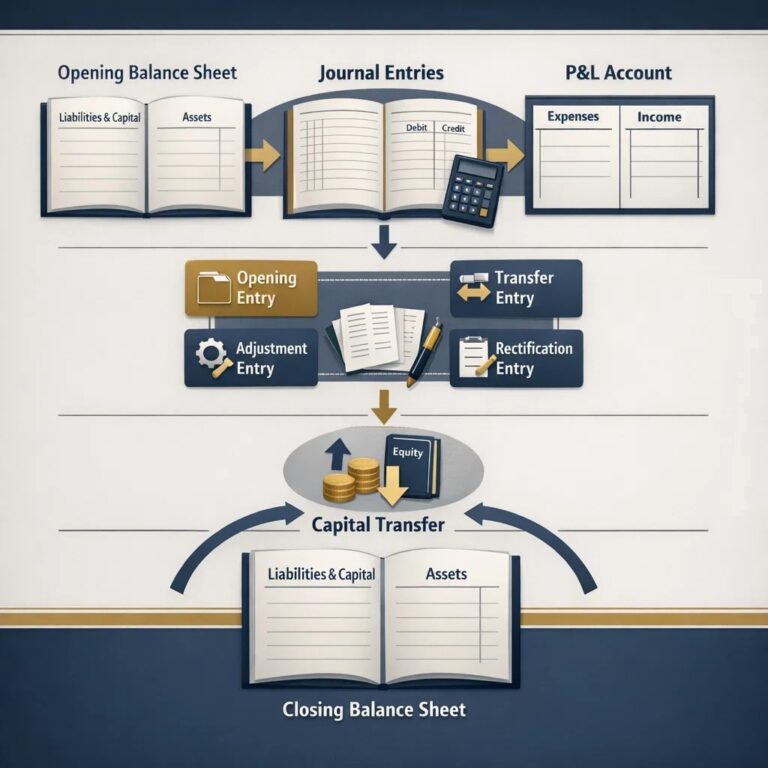
Day 25 – 50 Days Accounting Challenge | Accounting Made Easy for Class 11
Accounting students ka sabse common doubt hota hai:
👉 “Entry kaunsi pass karni hai, kab aur kyun?”
Isliye Day 25 me hum real figures + real flow ke saath samjhenge:
- Last Year Balance Sheet (31-03-2025)
- Current Year Profit & Loss Account
- Current Year Balance Sheet (31-03-2026)
- Types of Entries:
- Opening Entry
- Closing Entry
- Transfer Entry
- Adjustment Entry
- Rectification Entry
Sab kuch inter-linked hoga, taaki aapko accounting ratna nahi, balki samajhna aaye.
1️⃣ Last Year Balance Sheet (As on 31-03-2025)
📘 Balance Sheet – Previous Year
Liabilities
| Particulars | Amount (₹) |
| Capital | 5,00,000 |
| Long-Term Loan | 2,00,000 |
| Creditors | 1,20,000 |
| Outstanding Expenses | 30,000 |
| Total | 8,50,000 |
Assets
| Particulars | Amount (₹) |
| Land & Building | 3,50,000 |
| Machinery | 2,00,000 |
| Furniture | 80,000 |
| Closing Stock | 1,10,000 |
| Debtors | 70,000 |
| Cash | 40,000 |
| Total | 8,50,000 |
👉 Ye Balance Sheet naye saal ka base banti hai.
2️⃣ Opening Entry (01-04-2025)
🔹 Concept (Hinglish)
New accounting year ke start me, previous year ke assets aur liabilities ko books me lana hi Opening Entry kehlata hai.
👉 Capital balancing figure hota hai.
✍ Opening Journal Entry
Land & Building A/c Dr. 3,50,000
Machinery A/c Dr. 2,00,000
Furniture A/c Dr. 80,000
Stock A/c Dr. 1,10,000
Debtors A/c Dr. 70,000
Cash A/c Dr. 40,000
To Creditors A/c 1,20,000
To Outstanding Exp. A/c 30,000
To Long-Term Loan A/c 2,00,000
To Capital A/c 5,00,000
👉 Opening Entry sirf ek baar pass hoti hai – saal ke first day.
3️⃣ Profit & Loss Account (Year Ended 31-03-2026)
📈 Income Side
| Particulars | Amount (₹) |
| Gross Profit | 3,20,000 |
| Commission Received | 40,000 |
| Interest Received | 20,000 |
| Total Income | 3,80,000 |
📉 Expense Side
| Particulars | Amount (₹) |
| Salary | 1,20,000 |
| Rent | 60,000 |
| Electricity | 25,000 |
| Depreciation | 45,000 |
| Interest on Loan | 30,000 |
| Miscellaneous Expenses | 20,000 |
| Total Expenses | 3,00,000 |
✅ Net Profit
Net Profit = ₹80,000
4️⃣ Closing Entries
🔹 Concept (Hinglish)
Accounting year ke end par saare income aur expense accounts close karne padte hain — is process ko Closing Entries kehte hain.
✍ Closing Entry – Income
Income A/c Dr. 3,80,000
To P&L A/c 3,80,000
✍ Closing Entry – Expenses
P&L A/c Dr. 3,00,000
To Expenses A/c 3,00,000
👉 Iske baad P&L ka balance = Net Profit.
5️⃣ Transfer Entry (Profit to Capital)
🔹 Concept (Hinglish)
Profit business kamata hai, par owner ka haq hota hai.
Isliye profit Capital A/c me transfer hota hai.
✍ Transfer Entry
P&L A/c Dr. 80,000
To Capital A/c 80,000
6️⃣ Adjustment Entry (Matching Concept)
🔹 Example
Salary ₹10,000 outstanding hai.
✍ Adjustment Entry
Salary A/c Dr. 10,000
To Outstanding Salary A/c 10,000
👉 Expense bhi increase, liability bhi increase.
7️⃣ Rectification Entry (Error Correction)
🔹 Mistake
Furniture ₹15,000 ko Expense me debit kar diya gaya.
✍ Rectification Entry
Furniture A/c Dr. 15,000
To Misc Expense A/c 15,000
👉 Galat jagah se nikaal kar sahi jagah dalna = Rectification Entry
8️⃣ Current Year Balance Sheet (As on 31-03-2026)
📘 Balance Sheet – New Year
Liabilities
| Particulars | Amount (₹) |
| Capital (5,00,000 + 80,000) | 5,80,000 |
| Long-Term Loan | 2,00,000 |
| Creditors | 1,40,000 |
| Outstanding Expenses | 40,000 |
| Total | 9,60,000 |
Assets
| Particulars | Amount (₹) |
| Land & Building | 3,50,000 |
| Machinery | 1,80,000 |
| Furniture | 95,000 |
| Closing Stock | 1,30,000 |
| Debtors | 90,000 |
| Cash | 1,15,000 |
| Total | 9,60,000 |
9️⃣ One-Look Revision Table
| Entry Type | Kab Pass Hoti Hai |
| Opening Entry | New year start |
| Closing Entry | Year end |
| Transfer Entry | Profit/Loss transfer |
| Adjustment Entry | Accrual matching |
| Rectification Entry | Mistake correction |
🎯 Final Student Insight (Day 25)
Balance Sheet → Opening Entry → Transactions → P&L → Closing → Transfer → New Balance Sheet
Agar ye flow clear ho gaya, to accounting fear khatam.
Connect with CA Devesh Thakur
Stay updated with structured Income Tax learning, section-wise breakdowns, practical insights, and regular tax updates across platforms: